
A remarkable scientific discovery in the southeastern Indian Ocean has revealed what researchers are calling the most extensive and deepest whale resting ground ever recorded. Hidden far beneath the ocean surface, this ancient underwater landscape is changing how scientists understand deep sea life, whale evolution, and the ecosystems that exist in extreme environments.
The site lies within a remote geological feature known as the Diamantina fracture zone, where the seafloor plunges to depths greater than seven kilometers. Here, researchers uncovered an extraordinary concentration of whale remains, some dating back more than five million years, along with evidence of active and thriving deep sea communities.
A Burial Ground at the Edge of the Ocean World
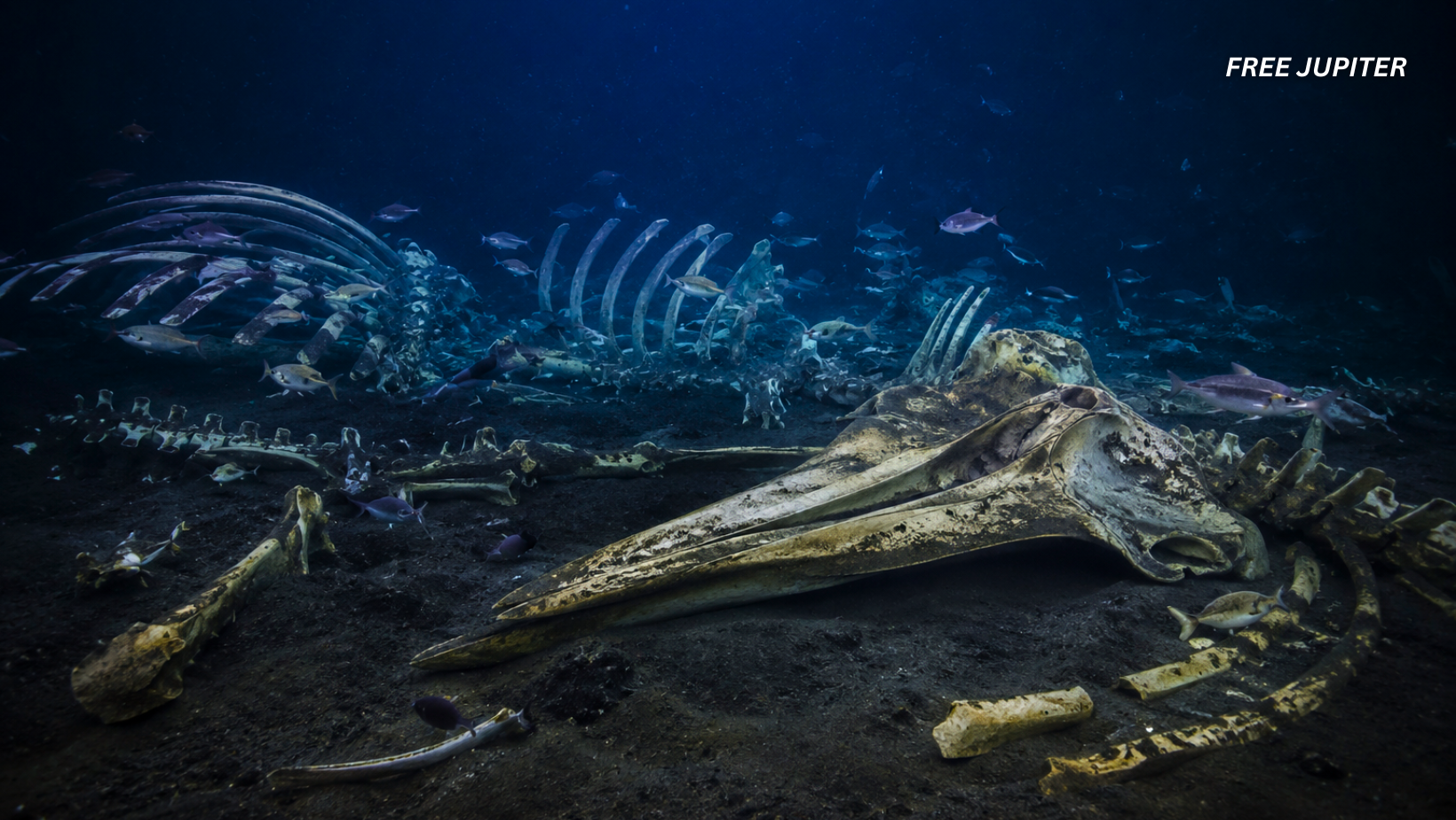
Whale falls occur when a whale dies and its body sinks to the seafloor. Over time, the carcass becomes a rich source of nutrients, supporting entire ecosystems in the deep ocean. These events are known, but they are rarely observed and usually found at depths shallower than four kilometers.
What makes this discovery so unusual is not just the number of whale remains, but the environment in which they were found. Instead of isolated cases, scientists documented a vast field of fossils and modern carcasses spread across hundreds of miles of seafloor. Some areas contained dense clusters of remains, creating what researchers describe as a vast underwater graveyard unlike anything seen before.
The deepest parts of this site reach more than seven kilometers below the ocean surface, placing it among the most extreme environments where complex life has been recorded.
Read more: Scientists Found a Planet With No Land, Only Oceans, And They’re Deeper Than Anything Found on Earth
Exploring the Diamantina Fracture Zone
The discovery was made by an international team of researchers from China, Italy, and New Zealand. They used a submersible vehicle to explore the rugged terrain of trenches and ridges formed millions of years ago when the Australian and Antarctic landmasses slowly drifted apart.
This geological separation created a complex landscape filled with cracks, valleys, and deep channels. Over time, it became a natural trap for sinking organic material, including the remains of whales that ended their lives in the open ocean.
During 32 deep sea dives, the research team mapped and examined the seafloor in detail. What they found exceeded expectations by a wide margin.
They identified 485 distinct fossil sites and also observed five modern whale falls in advanced stages of decomposition. Together, these findings suggest that the area has been repeatedly used as a long term resting place for whale remains across millions of years.
A Hidden Community Built on Death and Renewal
Even in the deepest and darkest parts of the ocean, life finds a way to thrive. The whale remains were not simply decaying in isolation. Instead, they were surrounded by a wide variety of deep sea organisms that depend on the nutrients released during decomposition.
Among the creatures discovered were crustaceans, mollusks, brittle star species, and bone consuming worms. These organisms specialize in breaking down whale bones and soft tissues, recycling nutrients in an environment where food is extremely limited.
Scientists also suspect that many of the species observed may be entirely new to science, highlighting how little is still known about life in the deep ocean.
The carcasses act as temporary oases in an otherwise food poor environment, supporting entire biological communities that can persist for decades after a whale has died.
Ancient Whales and Newly Identified Species
One of the most striking aspects of the discovery is the range of whale species represented in the fossil record. The largest skeleton recovered belonged to an Antarctic minke whale measuring around five meters in length.
Researchers also uncovered fossils belonging to extinct beaked whales, including a skull identified as Pterocetus benguelae, dated to approximately 5.3 million years ago. In addition, the team described another fossilized skull that represents a previously unknown species, now named Pterocetus diamantinae.
These findings provide rare insight into the long evolutionary history of deep diving whales and their relationship with changing ocean environments.
Beaked whales in particular are known for their deep diving behavior, often descending to extreme depths in search of squid. Their presence in this ancient system suggests that these waters may have long been part of important feeding and migration routes.
Read more: Scientists Confirm Earth Has an Eighth Continent Hidden Beneath the Ocean
A Vast Underwater Network of Whale Remains
One of the most surprising conclusions from the research is the scale of the site. The whale remains were not randomly scattered but instead aligned across a distance of roughly 1,200 kilometers.
This pattern has led scientists to propose the idea of a massive interconnected system of whale fall habitats, sometimes described as a community corridor. Within this corridor, whale carcasses may have provided a continuous source of nutrients across space and time, supporting a stable and evolving deep sea ecosystem.
In some areas, researchers estimate that there may be nearly 800 skeletons per square kilometer, a density far higher than anything previously recorded.
Life in One of the Most Extreme Environments on Earth
The conditions at these depths are among the harshest on the planet. There is no sunlight, temperatures are near freezing, and the pressure is immense. Yet despite these challenges, the discovery shows that life is not only present but highly organized and diverse.
Scientists emphasize that ecosystems like this demonstrate how adaptable marine life can be. Organisms have evolved to survive by exploiting rare but nutrient rich events such as whale falls, turning what appears to be death into a foundation for new life.
The site also offers valuable clues about how deep sea ecosystems respond over long periods of time. Because some of the remains date back millions of years, the area provides a natural archive of biological and environmental change.
Why This Discovery Matters for Science
Experts not involved in the study have described the site as one of the most significant deep sea discoveries in recent memory. It offers a rare opportunity to study both modern and ancient marine ecosystems in a single location.
Scientists believe it may help answer long standing questions about how deep sea species spread, how they survive in isolated environments, and how nutrient cycles operate in the deepest parts of the ocean.
It also highlights how much of the ocean remains unexplored. Despite advances in technology, vast regions of the deep sea are still poorly understood, and discoveries like this suggest that many more ecosystems may be waiting to be found.
Read more: Thousands of Barrels of Toxic Waste Dumped by U.S. Officials Are Now Leaking In The Ocean
A Glimpse Into an Unseen Ocean World
The whale graveyard in the Diamantina fracture zone reveals a hidden world where life and death are deeply connected. Over millions of years, whale remains have shaped an entire ecosystem, supporting species that thrive in one of the most extreme environments on Earth.
Far from being empty or lifeless, the deep ocean continues to surprise scientists with its complexity and richness. This discovery serves as a reminder that even in the most remote and inaccessible parts of the planet, nature is constantly building, adapting, and evolving in ways that are still not fully understood.
Featured image: GPT Original creation.
Friendly Note: FreeJupiter.com shares general information for curious minds. Please fact-check all claims and double-check health info with a qualified professional. Read our health-related content disclaimer here. 🌱