
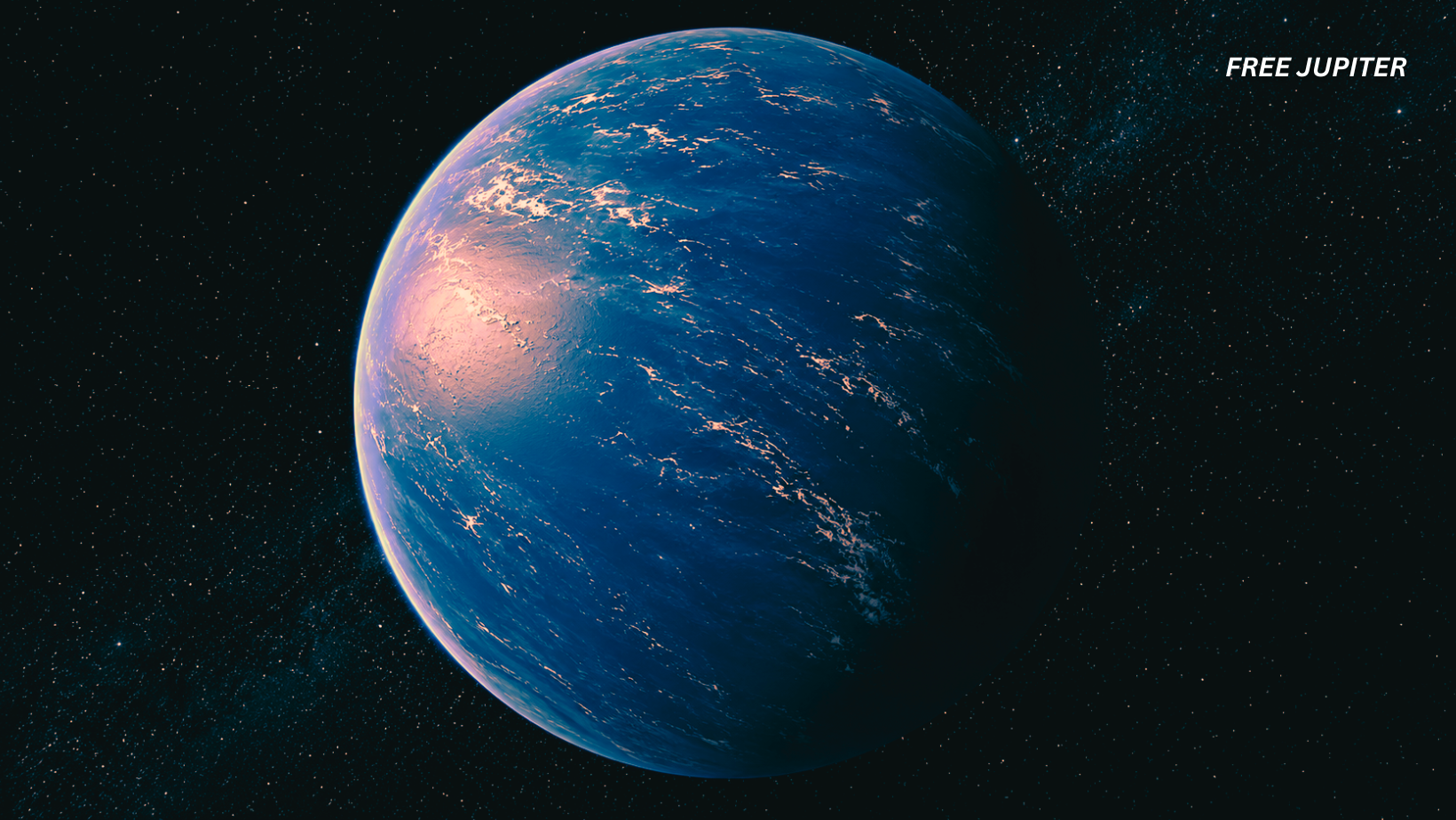
What would a planet look like if there were no continents, no islands, and not a single stretch of dry land anywhere on its surface?
It may sound like a setting from a science fiction novel, but astronomers believe such a world could actually exist. Far beyond our solar system lies TOI-1452 b, a fascinating exoplanet that appears to be covered almost entirely by water.
Unlike Earth, where oceans share the planet with vast continents and mountain ranges, TOI-1452 b may be home to a single endless ocean that wraps around the entire globe. If current scientific models are correct, this remarkable world could represent a type of planet that has no equivalent in our own cosmic neighborhood.
The discovery has sparked excitement among researchers because it offers a glimpse into the incredible diversity of planets that exist throughout the universe. It also raises intriguing questions about how planets form, how oceans evolve, and whether environments very different from Earth could potentially support life.
A Distant World in the Draco Constellation
TOI-1452 b is located approximately 100 light years from Earth in the constellation Draco. Although that distance may seem unimaginable, it is considered relatively close in astronomical terms.
The planet was identified using observations from NASA’s Transiting Exoplanet Survey Satellite, better known as TESS. This space telescope searches for planets by monitoring stars and looking for tiny dips in brightness that occur when a planet passes in front of its host star.
Through this method, scientists can estimate the planet’s size, orbit, and several other important characteristics.
What researchers found immediately stood out.
TOI-1452 b did not fit neatly into the categories of planets already familiar to scientists. Its size, mass, and density suggested that it could be something far more unusual.
Read more: Scientists Spot Two Planets That Collided in a Violent Cosmic Event That Will Give You The Chills
What Exactly Is a Super Earth?
TOI-1452 b belongs to a class of planets known as super Earths.
Despite the name, a super Earth is not necessarily a larger version of our own planet. The term simply refers to planets that are bigger and more massive than Earth but smaller than gas giants such as Jupiter and Saturn.
These worlds are among the most common types of planets discovered beyond our solar system. Interestingly, our own planetary neighborhood contains no super Earths, making them especially intriguing to astronomers.
TOI-1452 b is approximately 1.67 times larger than Earth in radius and nearly five times more massive. Those measurements place it firmly within the super Earth category.
However, it is the planet’s density that has truly captured scientific attention.
The Clue Hidden in the Planet’s Density
Scientists cannot travel to distant planets to collect samples, so they rely on indirect clues to understand what these worlds are made of.
One of the most important clues is density.
Density helps researchers estimate whether a planet is primarily composed of rock, metal, gas, water, or a combination of materials.
When astronomers calculated the density of TOI-1452 b, they found something surprising. The planet appeared too light to be made entirely of rock and metal, yet too dense to resemble a gas giant.
This unusual result led researchers to propose a compelling explanation.
A significant portion of the planet may consist of water.
According to some estimates, water could account for a substantial percentage of the planet’s total mass. That is dramatically different from Earth, where all oceans, rivers, lakes, glaciers, and underground water combined make up less than one percent of the planet’s overall mass.
If these estimates are accurate, TOI-1452 b may contain vastly more water than Earth has ever possessed.
An Ocean That Never Ends
Imagine standing on a world where the ocean stretches endlessly in every direction.
There would be no sandy beaches. No towering mountain ranges. No forests, deserts, or grasslands. The horizon would be defined entirely by water and sky.
Scientists believe TOI-1452 b may be one of these rare ocean worlds.
Beneath the surface, a rocky core could exist thousands of kilometers below the water. Above it, an enormous global ocean may extend across the entire planet.
The depth of this ocean is difficult to imagine.
Earth’s deepest known location, the Mariana Trench, reaches nearly 11 kilometers below sea level. On TOI-1452 b, the ocean could potentially be hundreds of kilometers deep in some regions.
Read more: Scientists Say An Ancient Impact With Another Planet Could Have Sparked Life on Earth
Could Life Exist on an Ocean World?
One of the most fascinating questions surrounding TOI-1452 b is whether life could potentially exist there.
Scientists have not found any evidence of life on the planet, and there is currently no way to know if living organisms inhabit its oceans.
Nevertheless, water is considered one of the essential ingredients for life as we know it. Wherever liquid water exists, the possibility of biological activity becomes an intriguing area of investigation.
Life on Earth thrives in environments once thought impossible, including deep ocean trenches, underwater volcanic vents, acidic lakes, and frozen polar regions.
These discoveries have encouraged scientists to broaden their understanding of where life might be able to survive.
At the same time, an ocean covered world presents unique challenges.
The James Webb Space Telescope Could Reveal More
One of the most powerful tools available to astronomers today is the James Webb Space Telescope.
Unlike traditional telescopes that focus mainly on capturing images, Webb can analyze the chemical makeup of distant planetary atmospheres.
As starlight passes through a planet’s atmosphere, certain gases leave unique signatures within the light. By studying these signatures, scientists can identify molecules such as water vapor, methane, carbon dioxide, and other compounds.
TOI-1452 b has become an attractive target for these investigations.
Future observations could reveal valuable information about the planet’s atmosphere, climate, and overall environment. These findings may help confirm whether the planet truly is a water dominated world.
A New Kind of Planetary Environment
The discovery of TOI-1452 b highlights how diverse the universe can be.
For centuries, humanity knew only the planets within our own solar system. Today, astronomers have identified thousands of exoplanets, many of which challenge traditional ideas about how planets should look and behave.
Some planets are hotter than molten lava. Others orbit two stars. Some experience extreme weather unlike anything seen on Earth.
TOI-1452 b joins this growing collection of extraordinary worlds.
If future studies confirm that it is covered almost entirely by water, it would represent one of the most compelling examples of an ocean planet ever discovered.
Read more: Humanity Has Officially Found 6,000 Exoplanets, NASA Announces
A Reminder of How Vast the Universe Really Is
Every new exoplanet discovery expands humanity’s understanding of what is possible beyond our solar system.
TOI-1452 b reminds us that Earth is just one version of a planet among countless possibilities scattered throughout the galaxy. While our world is defined by a balance of oceans and continents, other planets may be shaped by entirely different conditions.
Some may be dominated by ice. Others by gas. And some, like TOI-1452 b, may be ruled by endless oceans stretching across the entire globe.
Although many mysteries remain, this distant water world offers a fascinating glimpse into the incredible variety of environments that exist in the cosmos. As telescopes become more powerful and observations more detailed, scientists may soon uncover whether this extraordinary planet truly is a world where the ocean has no shore and land may not exist at all.
Featured image: GPT Original creation.
Friendly Note: FreeJupiter.com shares general information for curious minds. Please fact-check all claims and double-check health info with a qualified professional. 🌱