
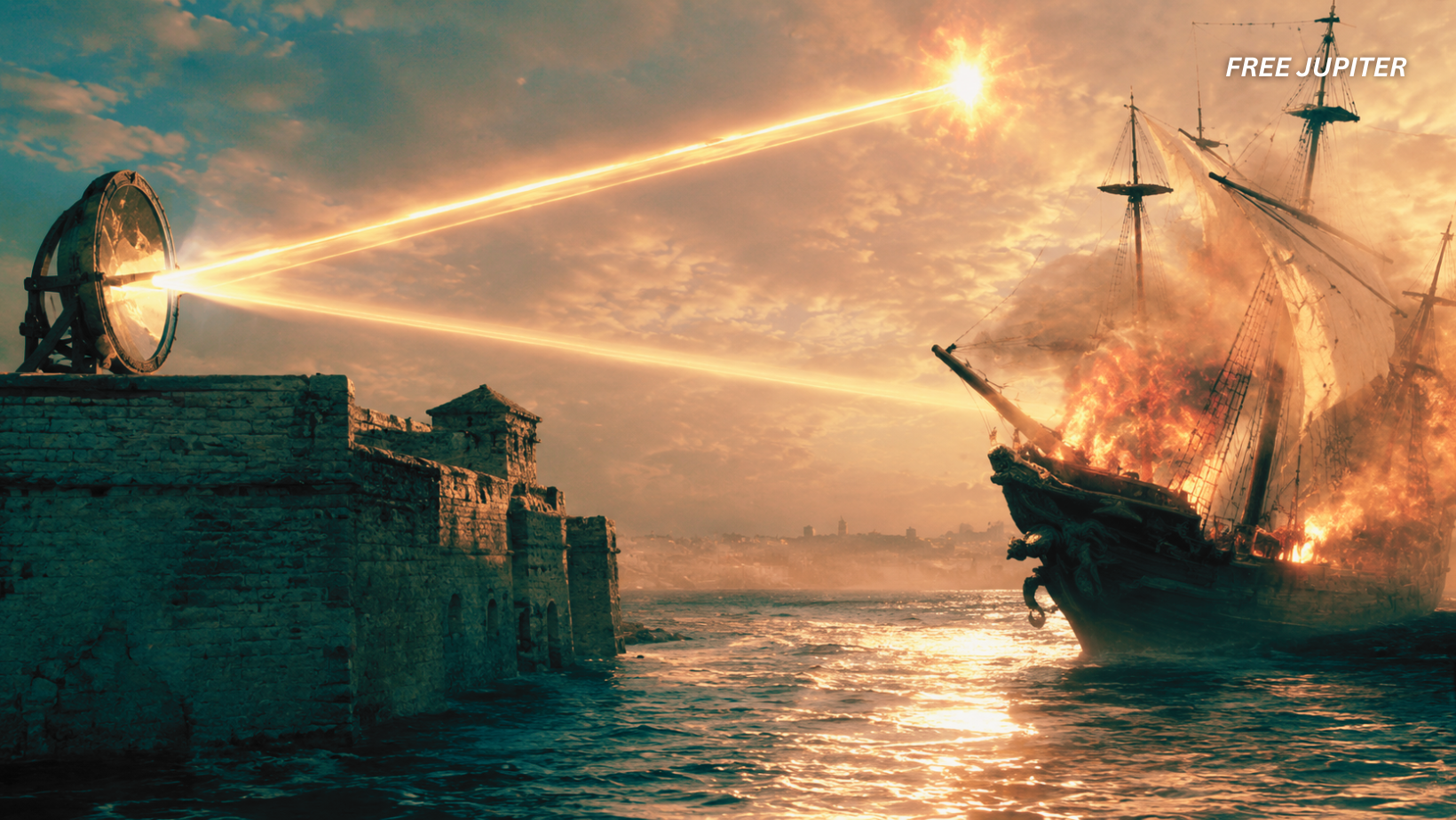
Ancient history has a way of sounding larger than life. Tales of impossible inventions, brilliant minds, and battlefield tricks often feel more like mythology than reality. One story that has fascinated historians for centuries involves the famous Greek mathematician Archimedes and his so called “death ray,” a device believed to use sunlight as a weapon against enemy ships.
For years, the idea has floated somewhere between science and legend. Could mirrors really focus enough sunlight to burn ships at sea? Most people would probably dismiss it as an exaggerated tale from the ancient world. Yet one Canadian teenager decided the story deserved a closer look.
What followed turned into an award winning science project that reignited debate around one of history’s strangest military legends.
Read more: Scientists Say Mercury Has a 10-Mile-Thick Layer of Diamonds Beneath Its Surface
A Young Student With an Unusual Curiosity
When Brenden Sener was just 12 years old, he became deeply interested in inventions from Ancient Greece. While many kids his age were focused on video games or sports, Sener was captivated by the work of Archimedes, one of history’s most influential thinkers.
The spark reportedly came during a family trip to Greece, where he learned about the inventions and scientific ideas connected to the ancient mathematician. At first, Sener experimented with the famous Archimedes screw, a machine designed to move water uphill. But eventually, his attention shifted toward a much more dramatic concept.
He became fascinated with the legendary death ray.
According to ancient stories, Archimedes designed a weapon capable of concentrating sunlight onto approaching Roman ships during the siege of Syracuse between 214 and 212 BC. The intense heat supposedly caused enemy vessels to burst into flames before they could attack the city.
The story has survived for centuries, although hard evidence has never been discovered.
The Mystery Behind the Archimedes Death Ray
Historians still debate whether the death ray was ever real. No archaeological proof has been found, and much of the story comes from accounts written long after the battle itself. Some versions claim the weapon used giant mirrors, while others suggest polished bronze shields reflected sunlight toward enemy ships.
Either way, the idea sounds almost unbelievable.
Still, from a scientific standpoint, the concept itself is not entirely impossible. Mirrors can reflect and concentrate light. Modern solar furnaces already use this principle to generate extremely high temperatures. The real question is whether people in the ancient world had the materials, precision, and coordination needed to turn sunlight into a battlefield weapon.
That question became the center of Sener’s experiment.
Testing an Ancient Idea With Modern Science
Rather than trying to recreate a massive naval weapon, Sener focused on the scientific principle behind the legend. His experiment explored whether mirrors could concentrate enough heat onto a target to significantly raise its temperature.
To test the idea, he built a smaller version of the supposed death ray using four concave mirrors and a heat lamp. Each mirror was carefully aimed at the same spot on a piece of cardboard.
As more mirrors were added, the temperature at the target area increased.
The results suggested that concentrated reflected light could indeed generate noticeable heat. While his setup did not ignite ships or recreate a full scale ancient weapon, it demonstrated that the core idea behind the death ray was scientifically reasonable.
In his paper published in the Canadian Science Fair Journal in 2024, Sener concluded that the principle behind the Archimedes death ray was “certainly possible.”
That statement is important because it avoids turning legend into fact. Sener did not claim Archimedes definitely built the weapon. Instead, he argued that the science behind the story holds up better than many people assume.
Read more: Here’s What Electric Cars Look Like Under Thermal Imaging Compared to Gas Vehicles
Could Ancient Greece Really Have Built It?
Even if the theory works in controlled conditions, turning it into a reliable military device would have been far more complicated.
Ships move constantly on water. Sunlight changes depending on weather conditions and time of day. Clouds could reduce effectiveness almost instantly. A large group of people would also need to align mirrors with incredible precision while under the pressure of battle.
Those challenges explain why many historians remain skeptical.
Still, some scientists believe the idea deserves more credit than it often receives. According to reports, Cliff Ho of Sandia National Laboratories praised Sener’s work and acknowledged that the concept could theoretically function, even if it may never have been widely used in combat.
The possibility alone keeps the mystery alive.
MythBusters and Other Famous Attempts
Sener was not the first person to investigate the death ray legend. Over the years, researchers, students, and television programs have all tried to test whether concentrated sunlight could destroy a ship.
The television series MythBusters famously attempted the experiment several times. Despite using large mirror arrays, the team failed to set a boat on fire during their tests.
However, the results were not completely dismissive. The experiments showed that reflected sunlight could create significant heat under the right conditions, though achieving sustained flames proved extremely difficult.
In 2005, students from Massachusetts Institute of Technology also conducted their own recreation attempt. According to reports, they successfully ignited part of a stationary boat during one test, although later attempts were less successful.
These mixed outcomes add another layer to the debate. The death ray may not have been the unstoppable superweapon described in legend, but the underlying science continues to show flashes of plausibility.
Why the Story Still Captures Attention
Part of the fascination surrounding Archimedes comes from how advanced his thinking was for his time. Long before modern engineering existed, he explored mathematics, mechanics, buoyancy, and machines in ways that shaped future science.
Sener himself expressed admiration for how innovative Archimedes was compared to others of his era. The ancient inventor’s ideas often sounded centuries ahead of the technology available around him.
That reputation makes the death ray story difficult to dismiss completely.
Human history is filled with inventions that once sounded impossible. Flight, electricity, and space travel all existed as fantasies before eventually becoming reality. While the death ray may never have functioned exactly as legends describe, the idea reflects humanity’s long standing fascination with using science in creative and unexpected ways.
From Ancient Legends to Modern Recognition
Sener’s project earned attention well beyond a typical classroom science fair. His research collected medals and recognition across Canadian science competitions. Since publishing his paper, he has also been listed on Team Canada 2025 for MILSET ESI, an international science event that highlights young innovators from around the world.
Later reports suggest he has continued pursuing advanced scientific research, including projects related to kidney stone studies.
His journey shows how curiosity about ancient myths can evolve into serious scientific exploration. A centuries old story about burning ships inspired a teenager to investigate optics, heat concentration, and engineering principles in a hands on way.
That alone may be the most impressive outcome of all.
A Legend That Refuses to Fade
The Archimedes death ray still exists in a strange space between history and imagination. No one can say with certainty whether the weapon was truly used during the siege of Syracuse. Evidence remains limited, and the dramatic details may have grown over time through retellings.
Yet experiments like Sener’s continue to reveal that the concept is not entirely absurd.
The science behind concentrated sunlight is real. Mirrors can intensify heat. Under ideal conditions, reflected solar energy can become powerful enough to scorch materials or even ignite them. Whether ancient soldiers managed to harness that power effectively in battle remains the unanswered part of the mystery.
For now, the death ray remains one of history’s most intriguing scientific legends. And thanks to one determined teenager, the conversation around it feels more alive than ever.
Featured image: GPT Recreation.
Friendly Note: FreeJupiter.com shares general information for curious minds. Please fact-check all claims and double-check health info with a qualified professional. 🌱