
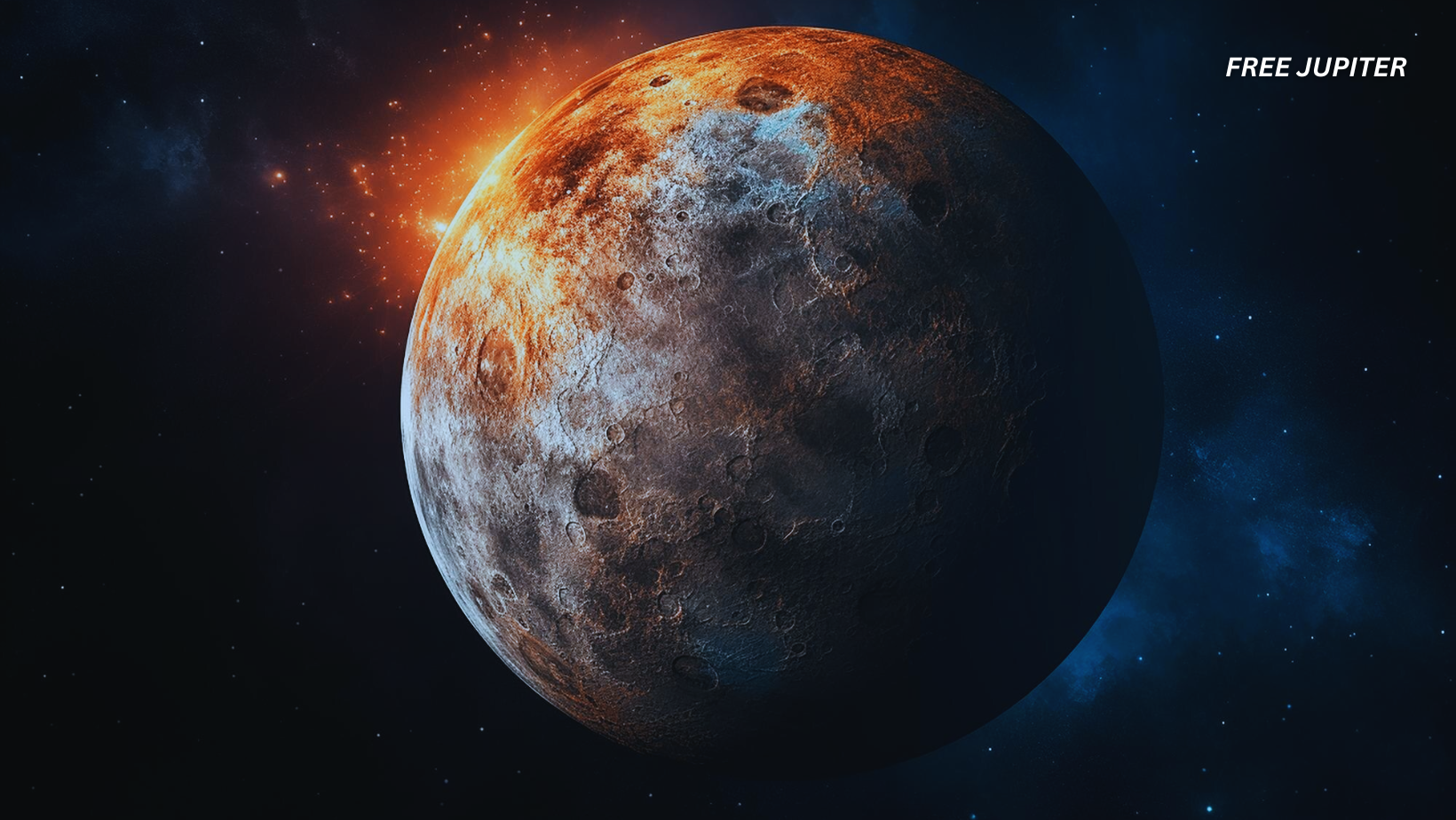
Mercury has never been the kind of planet people associate with beauty. It looks scorched, battered, and lifeless. The smallest planet in the Solar System appears more like a giant burned rock than a place filled with hidden wonders. Yet scientists now believe that deep beneath Mercury’s dark crust may lie something astonishing: a thick layer of diamonds buried close to the planet’s core.
This discovery does not mean giant sparkling gems are scattered across the surface waiting to be collected. Instead, researchers believe Mercury could contain an enormous underground diamond layer stretching for miles beneath the planet. If confirmed, it would make Mercury one of the strangest worlds in the Solar System.
The idea comes from a new scientific study based on data gathered by NASA’s MESSENGER spacecraft, combined with laboratory experiments designed to recreate the extreme conditions inside Mercury billions of years ago.
Scientists now think the planet’s dark surface may be hinting at a deeper story involving carbon, heat, pressure, and the violent formation of the early Solar System.
Read more: It Turns Out That Uranus And Neptune Might Not Actually Be Ice Giants After All, Study Says
Mercury’s Dark Surface Started the Mystery
For years, researchers have known that Mercury’s surface looks unusually dark compared to many other rocky planets. Data collected by the MESSENGER mission revealed that the darkness likely comes from graphite, a form of carbon also found in pencil lead.
Graphite is soft and lightweight, and scientists originally believed it formed during Mercury’s early history when the planet was covered by a massive ocean of molten rock called a magma ocean. As that molten material cooled, graphite floated upward and eventually formed part of Mercury’s crust.
That explanation seemed reasonable for a long time. However, new research published in the journal Nature Communications shows that Mercury’s carbon story may be far more complicated.
Scientists discovered that Mercury may have experienced enough pressure deep inside the planet to transform some of its carbon into diamond instead of graphite. While graphite forms under lower pressure conditions, diamonds require immense pressure and heat.
On Earth, diamonds are created deep underground where carbon becomes compressed over long periods of time. Mercury, despite being much smaller than Earth, may have developed similar conditions in its interior during its early formation.
A Planet Rich in Carbon
Mercury stands out from the other rocky planets because of its unusual chemistry. Researchers believe the planet formed closer to the Sun in a region filled with carbon rich material but relatively little oxygen.
That difference may sound small, but it completely changed how Mercury evolved.
Earth, Venus, and Mars contain more oxygen rich minerals. Mercury, on the other hand, developed under highly reduced chemical conditions, meaning oxygen played a smaller role while carbon became much more important.
This carbon rich environment may have allowed large amounts of carbon to sink deeper into the planet instead of remaining only near the surface.
Scientists studying Mercury’s crust found evidence that the carbon did not mainly arrive from asteroid impacts. Instead, the material appears to have originated from inside the planet itself. Deep impact craters exposed lower layers of Mercury’s crust, revealing carbon rich material hidden beneath the surface.
That discovery strengthened the idea that Mercury once had a carbon saturated magma ocean early in its history.
Read more: Humanity Has Officially Found 6,000 Exoplanets, NASA Announces
Recreating Mercury Inside a Laboratory
To explore the possibility of underground diamonds, researchers recreated Mercury like conditions in laboratory experiments.
Using powerful equipment capable of generating enormous pressure and heat, the team heated Mercury inspired materials to temperatures approaching 3,950 degrees Fahrenheit. These experiments allowed scientists to observe how minerals behaved under conditions similar to those deep inside the planet billions of years ago.
The researchers focused on materials resembling enstatite chondrites, a rare type of meteorite believed to resemble Mercury’s original building blocks.
One ingredient turned out to be especially important: sulfur.
Mercury contains far more sulfur than scientists once expected. The experiments showed that sulfur dramatically changes how molten rock behaves under high pressure. It lowered the temperature at which Mercury’s magma ocean began cooling and crystallizing.
That shift may have created the perfect conditions for diamonds to form.
Without sulfur, graphite remained the dominant carbon material. But when sulfur was added in large amounts, some of the experiments entered what scientists call the “diamond stability field,” meaning the conditions favored the creation of diamonds instead of graphite.
Even so, researchers believe this first process only created a relatively thin layer of diamonds.
The bigger surprise may have happened later, inside Mercury’s core.
Mercury’s Cooling Core May Have Produced Diamonds
About 4.5 billion years ago, Mercury’s metallic core was completely molten. Over time, the planet slowly cooled, and parts of the core began to solidify.
As the inner core crystallized, carbon became concentrated inside the remaining liquid metal surrounding it. Eventually, the liquid could no longer hold all that carbon.
Something had to form from the excess material.
According to the study, diamond became the most likely result.
Because diamonds are less dense than the liquid iron rich metal surrounding them, they would slowly rise upward through the outer core until reaching the boundary between Mercury’s core and mantle.
Over billions of years, those diamonds may have accumulated into a massive underground layer.
Researchers estimate this hidden diamond zone could measure between roughly 9 and 11 miles thick.
That is an extraordinary amount of diamond, even if it exists far beyond human reach.
Why This Discovery Matters
At first glance, underground diamonds on Mercury may sound like little more than a cosmic curiosity. But the discovery could help scientists better understand how planets form and evolve.
Mercury remains one of the most mysterious worlds in the Solar System. Despite being so close to Earth, many aspects of the planet still puzzle researchers.
For example, Mercury has an unusually large metallic core compared to its overall size. It also possesses a magnetic field, something scientists are still trying to fully explain.
The possible diamond layer may actually influence Mercury’s magnetic behavior.
Diamonds conduct heat extremely well. If a diamond rich layer exists near the planet’s core, it could affect how heat escapes from the molten metal inside Mercury. That process may influence how the planet generates its magnetic field.
In other words, the diamonds may not just be decorative geology. They could play an active role in shaping the planet itself.
Mercury Is Not the Only World With Possible Diamonds
Mercury may sound exotic, but scientists believe diamonds could exist in many places across the Solar System.
The giant planets Neptune and Uranus are among the most famous examples. Researchers suspect intense pressure inside these icy worlds may break apart methane molecules, forcing carbon atoms together into diamonds. Some theories even suggest literal diamond rain could fall deep inside those planets.
Jupiter and Saturn may experience similar processes. Lightning storms inside their atmospheres could produce carbon rich soot that eventually hardens into graphite and then compresses into diamonds as it sinks deeper into the planets.
Tiny diamonds have also been discovered inside meteorites found on Earth. These microscopic crystals likely formed during violent collisions in space or inside ancient asteroids.
Beyond our Solar System, scientists have even speculated about diamond rich exoplanets. One famous example is 55 Cancri e, a rocky world once proposed to contain large amounts of carbon based material under extreme pressure.
The universe, it seems, may produce diamonds far more often than people once imagined.
Read more: Huge Chunks of Ancient Space Objects Could Be Buried Inside Mars
A Strange Treasure Hidden Beneath Mercury
Mercury still appears gray, scorched, and lifeless from the outside. Yet beneath that burned exterior may lie one of the Solar System’s most unexpected geological secrets.
The idea of a planet hiding a buried diamond layer several miles thick feels almost surreal, but modern planetary science continues to reveal how strange and unpredictable worlds beyond Earth can be.
Researchers caution that the theory is not fully proven yet. Current models of Mercury’s interior cannot directly confirm the existence of the diamond layer. Future missions and more advanced measurements will be needed to test the idea further.
Still, the evidence has become compelling enough for scientists to take the possibility seriously.
A planet once dismissed as little more than a scorched rock may actually contain one of the most fascinating hidden structures in the Solar System.
Featured image: Freepik.
Friendly Note: FreeJupiter.com shares general information for curious minds. Please fact-check all claims and double-check health info with a qualified professional. 🌱