

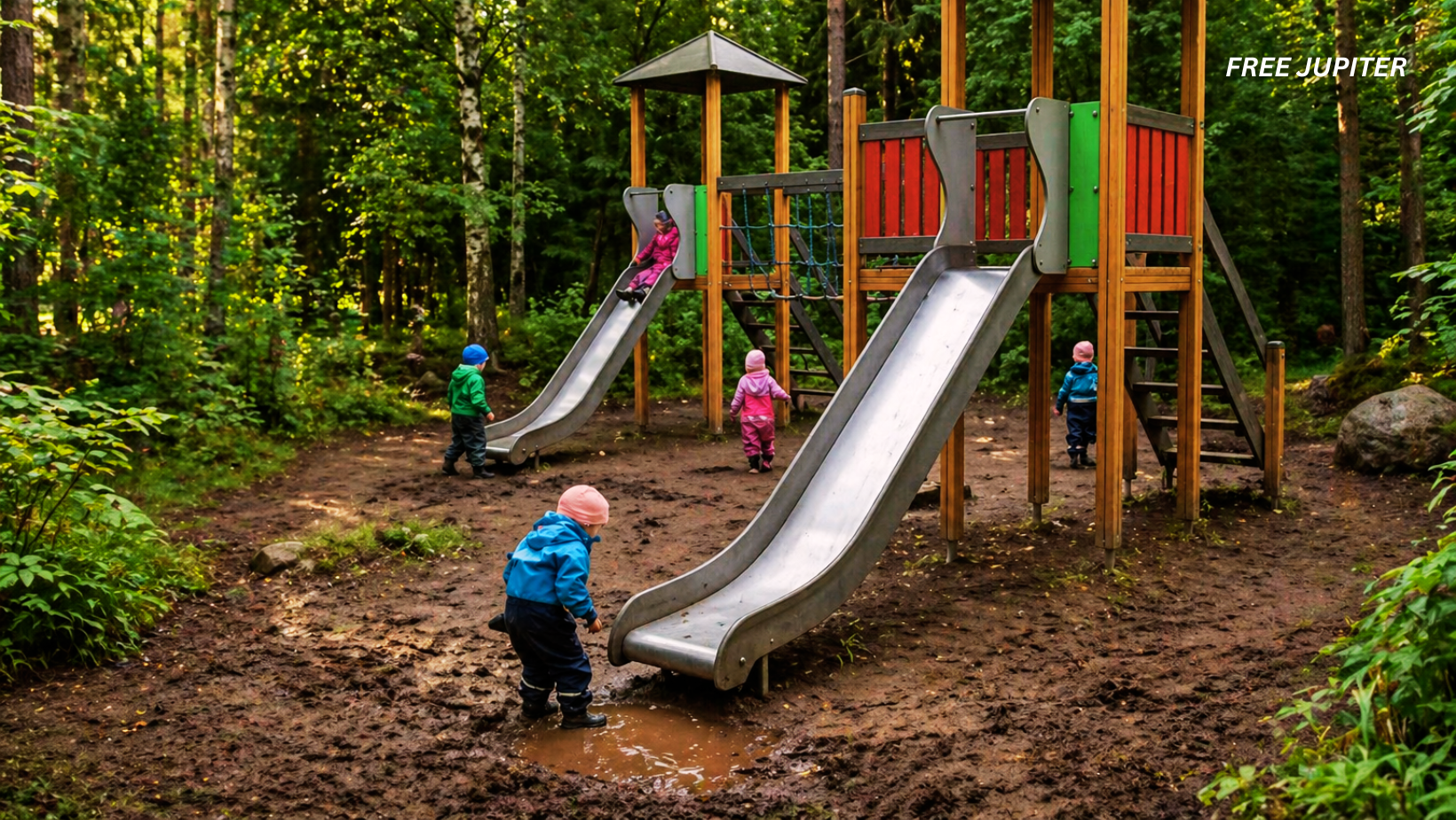
In a country known for its clean cities and thoughtful design, a simple experiment challenged a long held belief about childhood and cleanliness. Instead of making playgrounds smoother, safer looking, and more controlled, researchers in Finland tried something that felt almost old fashioned. They gave children back the mess.
At first glance, the idea seemed unusual. Playgrounds are often covered in rubber mats or gravel for safety and easy maintenance. These surfaces look neat and predictable. They are easy to clean and reduce visible dirt. Yet something essential may have been lost in the process. The Finnish study set out to explore what happens when that missing piece is restored.
Turning Playgrounds into Living Environments
In several nursery schools, traditional playground materials were replaced with elements that resembled a natural forest floor. Moss spread across the ground, patches of soil replaced hard surfaces, and leaf litter was allowed to settle the way it would in the wild. Small plants and undergrowth were introduced, creating a miniature ecosystem right where children played every day.
What happened next surprised even the researchers.
What Changed Inside the Body
Within just four weeks, noticeable changes began to appear in the children’s bodies. Not in ways that could be seen with the naked eye, but at a microscopic level that carries enormous importance. The communities of bacteria living on the children’s skin and inside their bodies became more diverse. This diversity is often linked to stronger health outcomes, especially when it comes to how the immune system behaves.
The human body is home to trillions of microorganisms. This living community, often referred to as the microbiome, plays a crucial role in keeping the body balanced. It helps train the immune system, teaching it how to respond to threats without overreacting. When this system lacks variety, it may become confused, sometimes responding aggressively to harmless substances like pollen or certain foods.
A Stronger, More Balanced Immune System
This is where the Finnish playground experiment becomes especially meaningful.
Children who spent time in the rewilded playgrounds showed an increase in what scientists call regulatory T cells. These cells act as the immune system’s moderators. They help prevent the body from launching unnecessary attacks, which are often the root of allergies and autoimmune conditions. In simple terms, their immune systems appeared to become better at staying calm and balanced.
The speed of the change was just as striking as the results. In less than a month, the children’s exposure to natural elements seemed to reshape how their bodies interacted with the world. This suggests that the environment does not just influence long term health in abstract ways. It can have a rapid and measurable impact.
The Biodiversity Hypothesis Explained
The findings support a growing idea in science often referred to as the biodiversity hypothesis. This concept proposes that modern urban living, with its focus on cleanliness and reduced contact with nature, may be limiting our exposure to beneficial microbes. As cities become more sanitized, the variety of microorganisms we encounter each day decreases. Over time, this may contribute to the rise in allergies and autoimmune diseases seen in many parts of the world.
In contrast, natural environments are rich with life at every level, including the microscopic. Soil, plants, and decaying leaves all host complex networks of bacteria and fungi. When children interact with these elements, even in simple ways like digging, running, or sitting on the ground, they come into contact with a broader range of microbes. This exposure appears to help the immune system learn and adapt more effectively.
Rewilding Beyond the Playground
The Finnish experiment did not rely on expensive technology or complicated medical treatments. It worked by reintroducing something basic and often overlooked. Nature itself.
This shift in thinking reflects a larger movement sometimes described as rewilding. While the term often brings to mind large scale environmental projects, its principles can be applied in everyday spaces. The goal is not to create perfect landscapes, but to allow natural processes to exist and thrive again, even in small areas.
A backyard does not need to be transformed into a dense forest to benefit from this approach. Even modest changes can make a difference. Allowing leaves to remain on the ground, planting native vegetation, or creating small patches of soil instead of covering everything with concrete or gravel can help rebuild these living systems. The same idea can extend to balconies or urban spaces, where containers filled with real soil and plants can introduce elements of biodiversity.
Read more: Taking This Vitamin for 3 Months Helps To “Reset” the Immune System, Scientists Say
Rethinking Cleanliness and Health
What makes this approach compelling is its simplicity. It does not ask for perfection or dramatic change. Instead, it encourages a shift in perspective. Dirt is no longer seen as something to be avoided at all costs, but as a meaningful part of a healthy environment.
Of course, this does not mean abandoning hygiene altogether. Clean water, proper sanitation, and safe living conditions remain essential. The lesson here is not about rejecting cleanliness, but about finding balance. There is a difference between harmful exposure and beneficial interaction with the natural world.
Why Children Benefit the Most
Children, in particular, seem to benefit from this balance. Their immune systems are still developing, learning how to respond to a wide range of inputs. Experiences during these early years can shape how the body reacts later in life. By giving them opportunities to engage with natural environments, even in small and controlled ways, it may be possible to support healthier development.
There is also an emotional and cognitive side to consider. Natural play environments tend to invite creativity and exploration. Uneven surfaces, varied textures, and living elements encourage children to interact more freely. This type of play can support not just physical health, but also curiosity and resilience.
A Healthier Future Rooted in Nature
The Finnish study offers a reminder that progress does not always mean adding more layers of control or complexity. Sometimes, it involves stepping back and allowing natural systems to do what they have always done.
In a world that often prioritizes convenience and uniformity, the idea of bringing back mud, moss, and soil might seem unconventional. Yet the evidence suggests that these humble elements hold real value. They connect us to a broader web of life that supports our well being in ways we are only beginning to understand.
Read more: Health Experts Say These 9 Fruits And Veggies Supercharge Your Immune System
As more communities consider how to design spaces for children and families, this research may inspire a different approach. One that values living surfaces over artificial ones, and diversity over uniformity.
The transformation seen in those Finnish playgrounds did not require years to unfold. It began with a simple change in what covered the ground beneath children’s feet. From there, a chain reaction followed, reaching deep into the biology of growing bodies.
In the end, the message is both practical and thought provoking. Health does not always come from what is added, but sometimes from what is allowed to return.
Featured image: GPT Recreation.
Friendly Note: FreeJupiter.com shares general information for curious minds. Please fact-check all claims and double-check health info with a qualified professional. 🌱