
When most people think about wild cats, the mind usually jumps to lions, tigers, or leopards. These large and powerful animals tend to dominate wildlife documentaries and nature headlines. Yet far from the spotlight, a collection of smaller feline species lives remarkable lives in some of the harshest environments on Earth. Among them is the sand cat, a tiny desert specialist with an unexpected talent. Unlike most cats, this one can produce a sound that resembles a dog’s bark.
The sand cat, scientifically known as Felis margarita, may be small in size, but it is impressively adapted to survival in extreme desert conditions. From its fur covered paws to its sharp hearing and unusual vocalizations, this animal proves that size has little to do with resilience.
Related article:Amsterdam Is Adding Tiny Staircases So Stray Cats Can Escape Its Canals
A Small Cat Built for a Big Desert
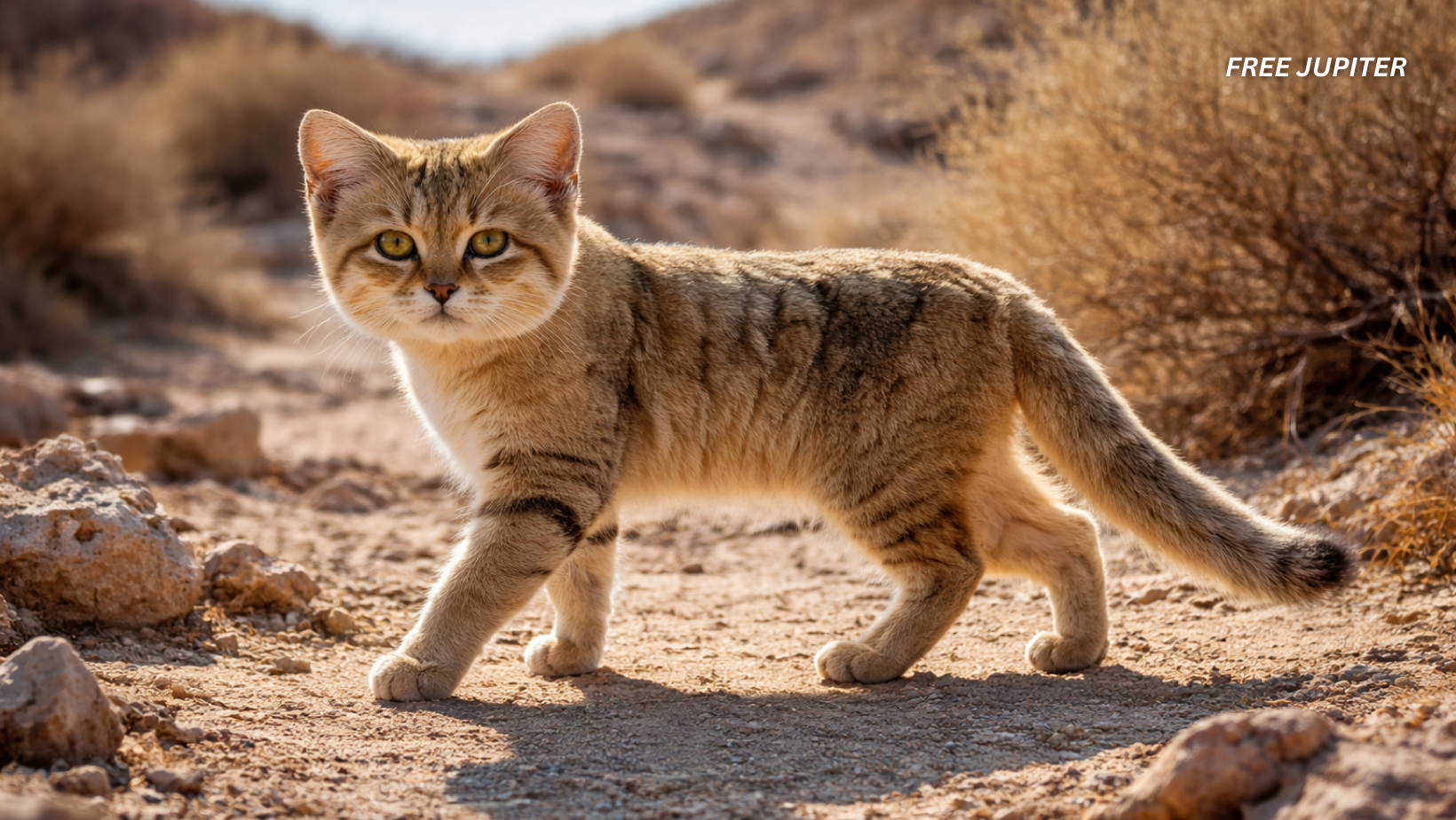
The sand cat is one of the smallest wild cat species in the world. Its body measures only about 45 to 57 centimeters in length, which is roughly the size of a large house cat. Its tail adds another 28 to 35 centimeters, giving it balance and agility as it moves across shifting dunes. In terms of weight, most individuals fall between 1 and 3 kilograms.
Although it may look delicate, this cat is anything but fragile. Its compact frame allows it to move efficiently across sand without sinking too deeply. Every part of its body appears designed for desert life.
One of its most noticeable features is its wide head and large ears. These ears are not just for show. They are highly sensitive and help the sand cat detect the faint sounds of prey moving beneath the sand. In a place where food can be scarce, being able to hear the slightest rustle can make the difference between going hungry and finding a meal.
The Only Cat That Truly Calls the Desert Home
While many wild cats can tolerate dry environments, the sand cat holds a unique distinction. It is the only member of the cat family that lives exclusively in true desert habitats. It does not rely on forests, grasslands, or wetlands. Instead, it thrives in sandy deserts where temperatures can soar during the day and drop sharply at night.
Its range stretches across parts of North Africa, the Middle East, and Central Asia. Populations have been recorded from Morocco across the Arabian Peninsula and into countries such as Pakistan, Kazakhstan, and Syria. Because these cats are elusive and leave very little trace behind, mapping their exact distribution remains challenging. Scientists know they prefer remote desert landscapes, but spotting them in the wild is rare.
A Nocturnal Hunter With Incredible Hearing
Life in the desert demands strategy. To avoid extreme daytime heat, sand cats are mainly nocturnal. They become active after sunset when temperatures are cooler and prey animals begin to stir.
Their hearing plays a crucial role in hunting. Instead of relying solely on sight, they often listen for movement beneath the sand. Many of their favorite prey species, such as gerbils, jirds, jerboas, and spiny mice, dig tunnels underground. The sand cat can detect these small creatures moving below the surface and then dig rapidly to catch them.
Their diet is not limited to rodents. They are also known to hunt small birds, young hares, and even reptiles. In the Sahara Desert, sand cats have been observed killing sand vipers. This is an impressive feat considering that these snakes are venomous. After making a catch, a sand cat may bury leftover food in the sand and return later to finish it. In an environment where meals are unpredictable, this behavior helps conserve energy and resources.
Fur Covered Feet and Vanishing Footprints
Walking barefoot on hot desert sand would be painful for most animals, but the sand cat has found a solution. The soles of its paws are covered in long, dense hair. This thick fur acts as insulation, protecting the cat from scorching surfaces during warmer hours.
These furry paws also serve another purpose. They reduce the visibility of footprints in the sand. As a result, tracking sand cats in the wild becomes extremely difficult. For researchers trying to study them, this presents a challenge. The cat moves across the desert leaving barely a trace, blending into the landscape both visually and physically.
Related article: Science Reveals How Cats Navigate Home Over Super Long Distances
Solitary but Not Silent
For most of the year, sand cats live alone. They establish territories and move independently across large areas of desert. However, during the breeding season, communication becomes essential.
This is where the sand cat reveals one of its most surprising traits. To locate potential mates across wide desert distances, it produces a distinctive call that sounds remarkably like the bark of a small dog or even the call of a seal. The sound can travel far across open terrain, making it easier for individuals to find each other.
The barking call works well with their excellent hearing. In a quiet desert night, these sounds can carry over long stretches of sand. It is an unusual vocalization for a feline, and it sets the sand cat apart from many of its relatives.
Masters of Digging
The sand cat is not only an efficient hunter but also an accomplished digger. It creates its own burrows in the sand, often using abandoned fox dens or enlarging existing holes. These underground shelters offer protection from extreme temperatures and provide a safe place to rest during the day.
Digging also helps during hunting. When prey attempts to hide below the surface, the sand cat can rapidly excavate the area with surprising speed. Its strong forelimbs and sharp claws are well suited for this task.
Living in burrows also helps protect young kittens when they are born. The underground environment offers a stable temperature compared to the shifting heat above ground.
Related article: These Traits Are Common in People Who Choose Dogs Over Cats
A Tiny Cat With a Big Story
At first glance, the sand cat may seem like just another small wild feline. However, a closer look reveals a creature shaped by one of the harshest environments on Earth. It is a desert specialist, a skilled hunter, an expert digger, and perhaps most surprisingly, a cat that can sound like a dog.
Its story challenges assumptions about what wild cats look like and how they behave. While lions roar and leopards stalk through forests, the sand cat moves across silent dunes, listening carefully for the faintest sign of life beneath the sand.
In the vast deserts stretching from North Africa to Central Asia, this small feline continues to survive against the odds. It does so not with brute strength, but with finely tuned adaptations and a voice that carries across the night air like an unexpected bark.
For those willing to look beyond the well known icons of the animal kingdom, the sand cat offers something refreshing. It is proof that even the smallest predators can hold some of nature’s most fascinating secrets.
Featured image: GPT Recreation for Illustration.
Friendly Note: FreeJupiter.com shares general information for curious minds. Please fact-check all claims and double-check health info with a qualified professional. 🌱