

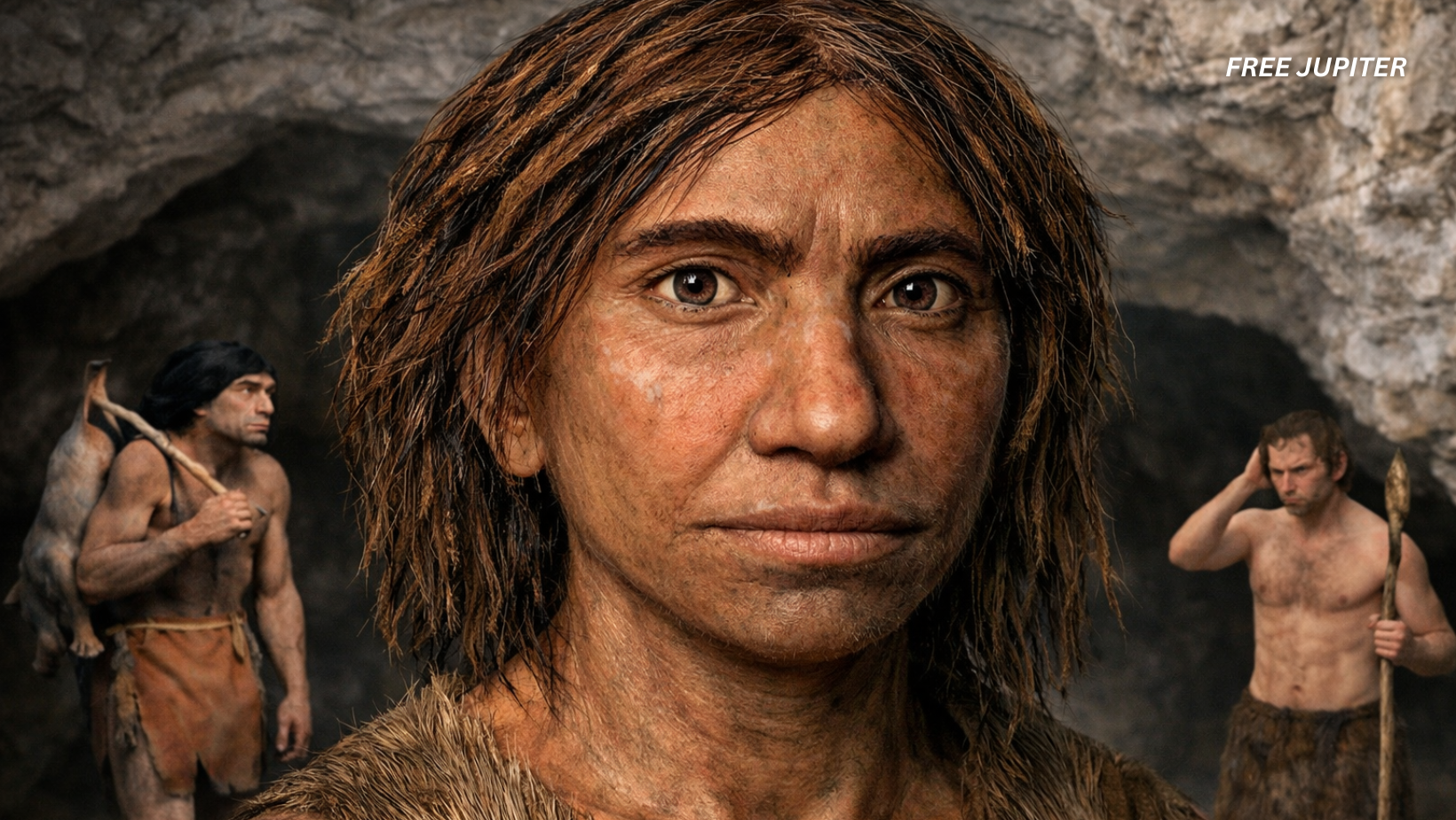
The story of human evolution continues to evolve in unexpected ways. For many years, scientists believed the journey toward modern humans followed a relatively simple path, with a few known ancient relatives branching off along the way. Yet new fossil discoveries often reveal a far richer and more intricate story.
Recently, researchers announced the identification of a previously unknown human species that once lived in what is now China. The species has been named Homo juluensis, and its discovery is providing new insight into how diverse the human family once was. According to scientists, this ancient group lived roughly 200,000 years ago and possessed physical features that set them apart from other known human relatives.
The identification of Homo juluensis is being viewed as an important development in the study of human evolution. By examining ancient fossils and comparing them with previously discovered remains, researchers have begun to fill in missing chapters of humanity’s deep past. The finding suggests that ancient Asia was once home to a variety of human groups living at the same time, each adapting to its environment in unique ways.
Related article: Researchers Recover The Complete Woolly Rhino Genome From Inside an Ancient Wolf Pup
A Remarkable Fossil Discovery
The fossils that led to the recognition of Homo juluensis were discovered in northern China. For years, the remains puzzled scientists because they did not perfectly match any known human species. Their features seemed to share characteristics with several different ancient groups, which made classification difficult.
After careful analysis, a team of paleoanthropologists concluded that these fossils represented something entirely new. By studying skull fragments, jawbones, and other skeletal remains, the researchers determined that the individuals belonged to a previously unrecognized branch of the human family tree.
One of the most striking characteristics of these ancient humans was the size of their skulls. The braincases measured around 1,700 cubic centimeters. To put that into perspective, the average brain volume of modern humans is roughly 1,350 cubic centimeters. This suggests that Homo juluensis possessed notably large heads compared with people today.
This feature alone caught the attention of scientists. However, the skull shape and bone structure also revealed important clues. The fossils displayed a combination of traits that appeared both familiar and unusual, suggesting a lineage that had followed its own evolutionary path for thousands of years.
A Larger Than Expected Ancient Population
The discovery of Homo juluensis highlights an important reality about early human history. Rather than a single line of evolution gradually transforming into modern humans, multiple human groups lived across the planet at the same time.
Ancient Earth was once populated by a variety of human relatives. These included Neanderthals in Europe, Denisovans in parts of Asia, and other groups that scientists are still working to understand. Each of these populations developed distinctive traits shaped by their environment.
The fossils attributed to Homo juluensis add another piece to this complex puzzle. Their presence in China suggests that East Asia was home to a wide range of human populations interacting, adapting, and evolving over long periods.
For researchers studying human origins, this diversity is both exciting and challenging. It means that the story of human evolution is far more layered than earlier theories suggested.
Life in Ancient China
The fossil evidence provides clues about how Homo juluensis may have lived. Scientists believe these individuals were skilled hunter gatherers who survived in groups. Like many ancient human populations, cooperation likely played an essential role in their daily lives.
Evidence from archaeological sites suggests that these people hunted wild horses and other animals. Hunting large prey would have required planning and coordination, indicating that they possessed advanced social behavior and communication skills.
Stone tools discovered alongside the fossils offer further insight into their abilities. The tools appear to have been carefully shaped and designed for specific tasks. This suggests that Homo juluensis had developed sophisticated techniques for cutting, scraping, and processing food.
Such tools also indicate that these ancient humans were capable of adapting to challenging environments. Northern China during that period likely experienced fluctuating climates, which would have required flexible survival strategies.
A Possible Link to Denisovans
One of the most intriguing aspects of this discovery is the possibility that Homo juluensis may be connected to a mysterious ancient human group known as the Denisovans.
Denisovans were first identified through genetic evidence extracted from fossils discovered in Siberia. Unlike Neanderthals, whose skeletal remains are relatively well documented, Denisovans are known mostly from fragments of bone and DNA.
Because of this limited evidence, scientists have long struggled to determine what Denisovans actually looked like. The identification of Homo juluensis raises the possibility that some fossils previously attributed to Denisovans might belong to this newly recognized species.
If this connection proves correct, it could help scientists better understand Denisovan anatomy and behavior. It would also provide a clearer picture of how these ancient populations interacted with each other.
Genetic studies have already shown that Denisovans interbred with modern humans thousands of years ago. Today, traces of Denisovan DNA can still be found in certain populations, particularly among people living in parts of Asia and the Pacific.
Related article: Bizarre Metal From Outside Our World Spotted in Ancient Treasure Stash
The Complexity of Human Evolution
For much of the twentieth century, human evolution was often presented as a simple progression. In this view, one species gradually replaced another until modern humans eventually appeared.
Modern research has revealed that this picture is far too simplified. Instead of a straight line, human evolution resembles a branching tree filled with overlapping species and unexpected connections.
The recognition of Homo juluensis reinforces this idea. It shows that many different human populations once lived across the world, each developing its own characteristics over time.
Some groups disappeared completely, leaving only fossils behind. Others interbred with different populations, passing on small fragments of their genetic heritage. The result is a complex web of relationships that scientists are still working to untangle.
Ancient Asia as a Human Crossroads
The discovery of Homo juluensis also highlights the importance of Asia in the story of human evolution. For many years, research focused heavily on Africa and Europe, where numerous fossils had already been found.
However, recent discoveries in Asia are revealing that the region played a major role in shaping early human diversity.
Evidence now suggests that ancient Asia hosted several distinct human populations living at the same time. These groups may have interacted with one another, sharing territory, resources, and occasionally genetic material.
Understanding these relationships is essential for building a complete picture of humanity’s past. Each new fossil discovery provides another piece of the puzzle.
Related article: Archaeologists Find an Ancient Temple Hidden in the Heart of a Cliff
A More Diverse Human Family
Ultimately, the discovery of Homo juluensis paints a vivid picture of a world once filled with many kinds of humans. Long before modern humans became the dominant population on Earth, different human groups were exploring landscapes, developing tools, and adapting to their environments.
Rather than a single path toward modern humanity, the evolutionary journey appears to have been shaped by numerous branches. Some lines thrived for thousands of years before fading away. Others left traces that continue to influence human populations today.
As new fossils emerge and scientific methods advance, the story of human evolution will likely become even more fascinating. Each discovery brings scientists one step closer to understanding how modern humans came to exist.
The recognition of Homo juluensis stands as another chapter in that ongoing exploration. It reveals that the ancient human family tree was broader, richer, and more complex than once imagined.
Featured image: Freepik.
Friendly Note: FreeJupiter.com shares general information for curious minds. Please fact-check all claims and double-check health info with a qualified professional. 🌱