

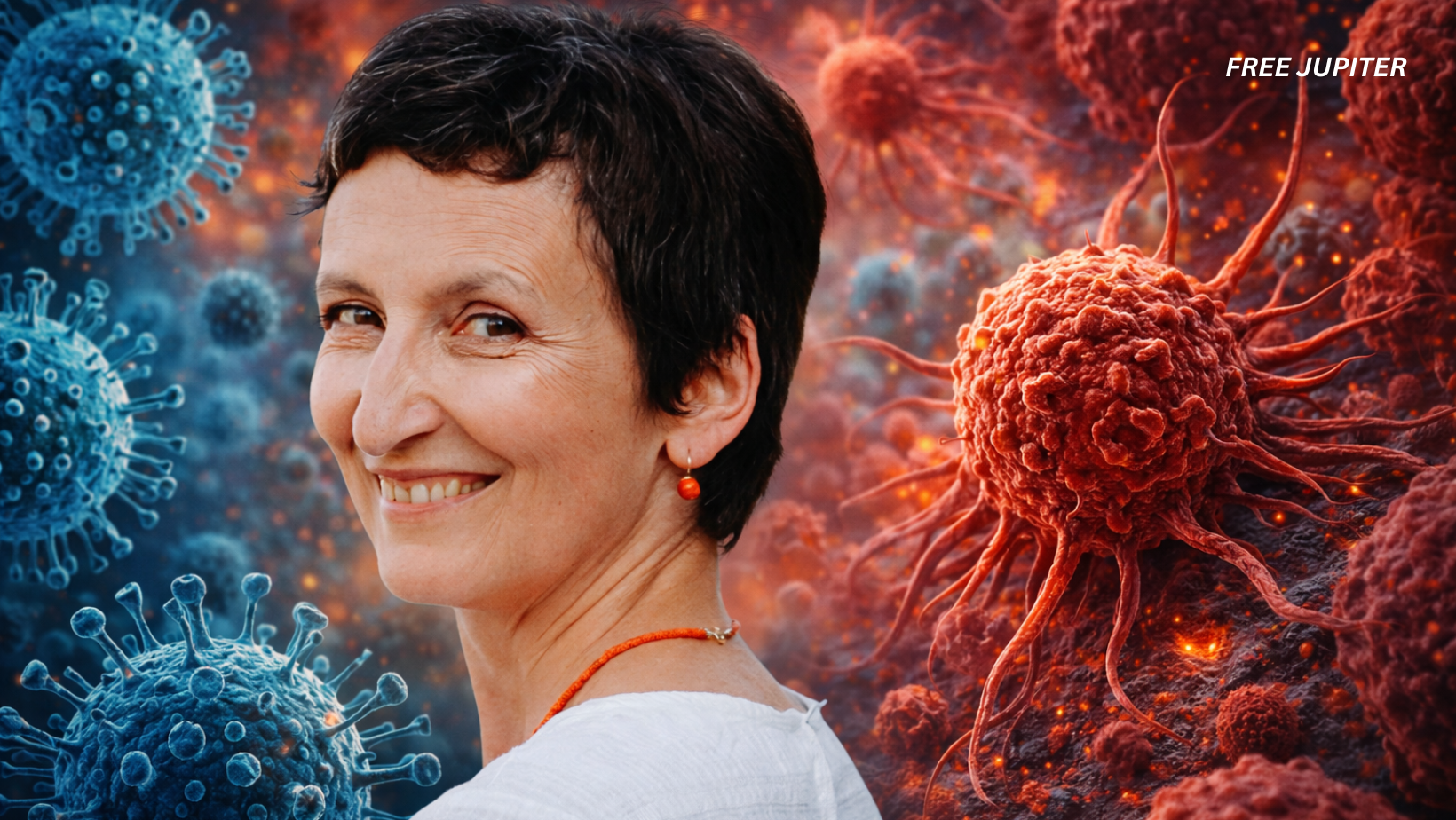
When Beata Halassy discovered in the summer of 2020 that her breast cancer had returned, she faced a frightening reality. Many patients might have followed a traditional route, chemotherapy, radiation, or surgery, but Halassy chose a path that was as daring as it was unusual.
As a virologist at the University of Zagreb in Croatia, she had spent years studying viruses, observing how they interact with the human body and how they can sometimes be harnessed to fight diseases. She knew that researchers around the world were exploring virus-based therapies for cancer, aiming to attack tumors while avoiding the destructive side effects often caused by conventional treatments.
Armed with this knowledge, she decided to become her own patient.
With her oncologists’ approval, Halassy worked with colleagues to test two types of viruses that she had grown in her laboratory. These viruses were injected directly into her tumor over several weeks. The results were remarkable. The tumor gradually shrank, eventually reaching a size that surgeons could safely remove.
Her experiment, documented in the peer-reviewed journal Vaccines in August, reports that she has been in remission for nearly four years.
A Controversial Choice in Medicine
Self-experimentation has a long and sometimes controversial history in medical science. Some bioethicists view it as a bold expression of curiosity and dedication, while others caution that it can be risky and prone to bias.
“From my perspective, self-experimentation is not fundamentally unethical,” said Alta Charo, a professor emerita of law and bioethics at the University of Wisconsin at Madison. “It may be unwise. It may indeed be tainted by an unrealistic set of expectations. But I don’t see it as fundamentally unethical.”
Critics argue that even a highly trained researcher like Halassy can struggle to maintain objectivity when experimenting on herself. Moreover, a single case cannot provide enough evidence to prove that a treatment will be safe or effective for others.
Related article:Japanese Tree Frog Gut Bacteria Shows Stunning Ability To Wipe Out Cancer Tumors In Mice
The Science Behind Virus-Based Cancer Therapy
The idea of using viruses to fight cancer may sound counterintuitive. After all, viruses are often thought of as harmful invaders that make people sick. But some viruses can be engineered or selected to target cancer cells specifically while leaving healthy cells mostly unharmed. This approach is known as oncolytic virus therapy (OVT).
Oncolytic viruses work in several ways. First, they infect and multiply within cancer cells, causing the cells to burst and die. Second, the immune system detects the viral infection and mounts a stronger response against the tumor. This dual effect makes oncolytic viruses an attractive alternative or complement to traditional treatments.
The FDA first approved an oncolytic virus therapy in 2015 for treating melanoma, a type of skin cancer. Since then, researchers have been exploring whether this therapy can help treat other cancers, including breast, brain, and lung cancers. One challenge, however, is that many clinical trials are conducted on patients whose health has already been compromised by chemotherapy or radiation, which can affect the results.
Halassy’s case was different. She had been diagnosed with breast cancer in 2016 and had completed chemotherapy years earlier. She was healthy enough to be a viable candidate for an experimental therapy, and uniquely qualified to prepare and administer it herself.
The Viruses Halassy Used
Halassy’s treatment involved two types of viruses. The first was a measles virus strain commonly used in vaccines. Measles virus has a natural tendency to infect cancer cells more efficiently than normal cells, making it an excellent candidate for oncolytic therapy. The second virus was vesicular stomatitis virus (VSV), which typically infects livestock but can be adapted to target human cancer cells safely in controlled laboratory conditions.
Over a period of about six weeks, these viruses were injected directly into her tumor at scheduled intervals. Approximately eleven days after the first injection, her tumor began to shrink. By the end of the six weeks, it had reduced enough to be surgically removed. Apart from a short fever on one day, she experienced few side effects.
Comparing Virus Therapy to Conventional Treatments
Traditional cancer treatments like chemotherapy and radiation can be highly effective but often come with significant drawbacks. Chemotherapy attacks fast, growing cells indiscriminately, which can damage healthy tissues, causing hair loss, fatigue, nausea, and immune suppression. Radiation targets specific areas but can also harm surrounding healthy tissue. Both treatments can leave lasting effects on a patient’s quality of life.
Virus-based therapies offer a different approach. By targeting cancer cells specifically and leveraging the body’s immune response, they can minimize collateral damage. However, OVT is still largely experimental. Large-scale clinical trials are needed to determine how effective it is across different types of cancer and patient conditions. Halassy’s case, while promising, is only one data point in a broader scientific landscape.
Related article:Science Shows The Most Effective Way To Detox Your Brain This New Year
A Tradition of Self-Experimentation
Halassy’s decision to test her treatment on herself places her in a long line of researchers who have done the same throughout history. Some of these experiments have led to significant breakthroughs, while others ended tragically.
In the late 19th century, American physician Jesse Lazear allowed himself to be bitten by a mosquito to prove how yellow fever spread. He died from the disease. Similarly, Peruvian medical student Daniel Carrión intentionally infected himself with a bacterium causing a condition later named Carrión’s disease, which also proved fatal.
Not all self-experiments ended in death, of course. Some have resulted in groundbreaking medical discoveries. These stories illustrate the delicate balance between scientific curiosity and personal risk, highlighting the courage and sometimes extraordinary commitment of researchers willing to place themselves at the forefront of experimental medicine.
Ethical and Practical Considerations
Despite her success, Halassy’s self-experimentation raises questions. Critics argue that even highly trained researchers can struggle to give unbiased consent when they are both scientist and subject. Hank Greely, director of Stanford University’s Center for Law and the Biosciences, explained that doctors are generally advised not to treat themselves or family members, precisely because it is difficult to remain objective about risks and benefits.
Halassy’s study did not undergo a formal ethics review, which is typical for cases of self-experimentation. The researchers argued that she was fully informed about her condition and the available therapies, and she wanted to pursue an innovative approach in a scientifically rigorous way.
Still, bioethicists caution that publicizing such experiments could encourage less qualified individuals to attempt self-treatment with potentially dangerous consequences. Furthermore, a single case does not provide enough data to draw broad conclusions about the safety or effectiveness of the therapy.
“Not every experiment is research,” Charo noted. A self-experiment, even if successful, cannot replace carefully designed clinical trials.
Implications for Future Cancer Treatment
Halassy and her colleagues acknowledged the limitations of their study but emphasized its potential to inspire future research. They suggested that early-stage clinical trials could explore how oncolytic virus therapy might complement or even replace conventional treatments for some patients. They also noted that her case is difficult to replicate because it required a patient with specialized knowledge and access to a laboratory capable of safely producing therapeutic viruses.
Her success demonstrates that virus-based treatments have the potential to shrink tumors with relatively few side effects. It highlights the promise of a treatment that can attack cancer directly, sparing healthy cells, and stimulating the immune system—a combination that is difficult to achieve with traditional therapies alone.
Related article:This Common Vitamin Will Help Protect Your Lungs From Air Pollution
A Personal Victory
After facing a recurrence of breast cancer twice since her initial diagnosis in 2016, Halassy has now been cancer-free for 45 months. Her case offers hope and inspiration, showing that innovative approaches, when carefully considered and executed, can lead to remarkable outcomes.
Halassy’s story also underscores the importance of expertise, preparation, and caution. Self-experimentation is not a path that most patients should attempt, nor is it a substitute for clinical trials. Instead, it serves as a window into what future cancer therapies might look like, combining cutting-edge science with ingenuity and personal courage.
In the end, Halassy’s work reminds us that science often advances through daring, curiosity, and the willingness to explore uncharted territory. Her success is a testament to the potential of oncolytic virus therapy and an example of how innovative approaches may one day transform the way we treat cancer.
By harnessing viruses to fight tumors while minimizing harm to healthy cells, Halassy’s experiment points to a future in which cancer treatment may become more precise, less destructive, and potentially far more effective. It also reflects the dedication of researchers who, sometimes literally, put themselves on the line to push the boundaries of medical knowledge.
Featured image: GPT recreation.
Friendly Note: FreeJupiter.com shares general information for curious minds. Please fact-check all claims and double-check health info with a qualified professional. 🌱