
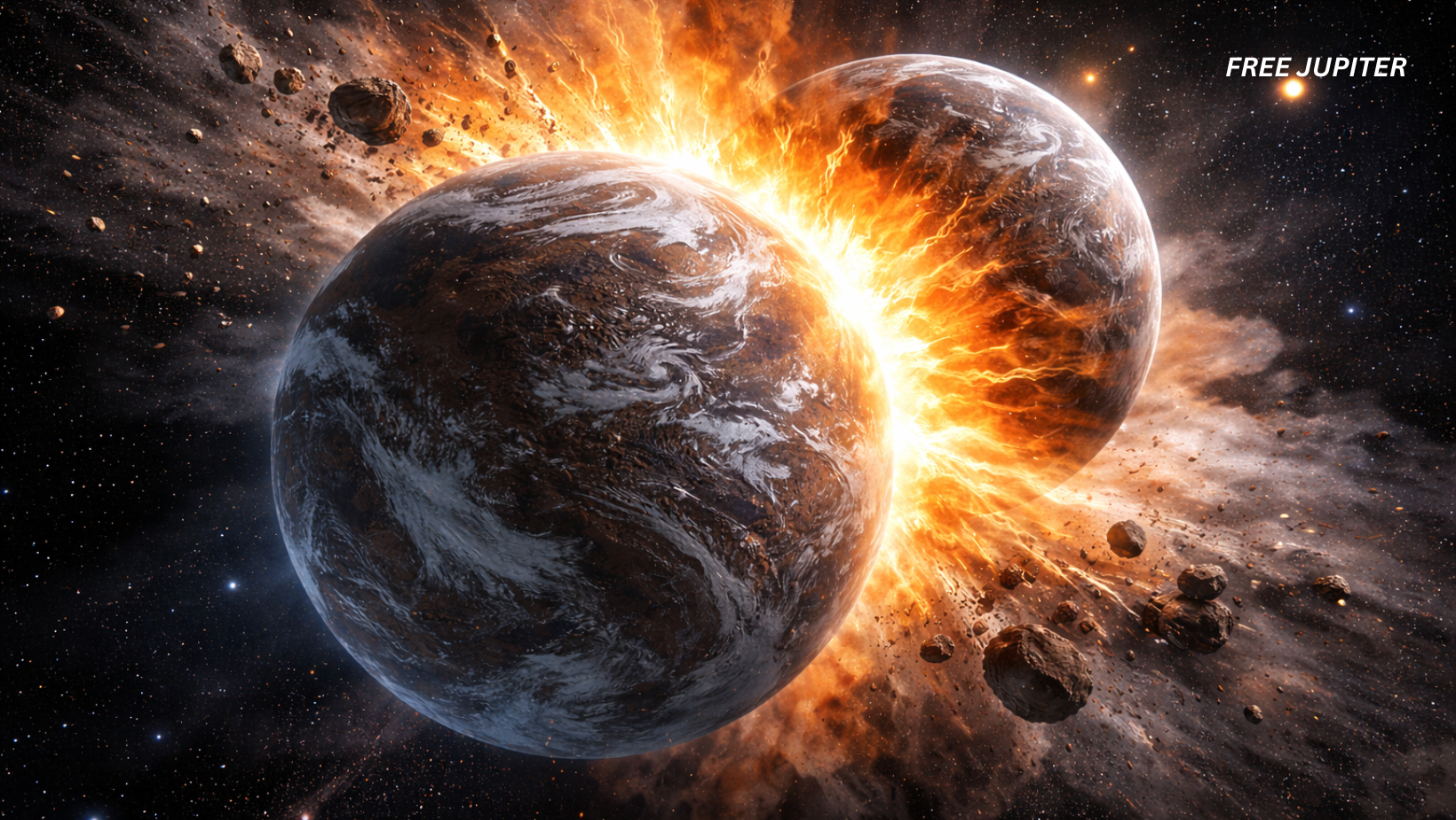
Somewhere far beyond our solar system, a dramatic event has unfolded. It was not a gentle meeting or a slow transformation. It was a violent collision between two planets, an event so intense that it sent massive clouds of debris drifting across space. Scientists believe they have finally caught clear evidence of this kind of planetary crash, offering a rare glimpse into how planets and even moons might form.
The study was published in the journal The Astrophysical Journal Letters.
At first glance, the story begins with something that looked completely ordinary. A distant star, known as Gaia20ehk, behaved like countless others in the universe. It shone with a steady, predictable brightness, much like our own Sun. Nothing about it seemed unusual. But then, something changed.
Around 2016, astronomers noticed that the star’s light began to dip in strange and irregular ways. These dips were not subtle. They appeared as sudden drops in brightness, as if something large was passing in front of the star and blocking its light. Over time, the behavior became even more unusual. By 2021, the star’s light patterns had become chaotic, drawing serious attention from researchers.
Related article: Scientists Say An Ancient Impact With Another Planet Could Have Sparked Life on Earth
Not the Star, But Something in Front of It
At first, this kind of flickering might suggest that the star itself was unstable. But scientists quickly ruled that out. Stars like Gaia20ehk, especially those similar to our Sun, are not known to behave this way. Their light output tends to remain steady over long periods. So if the star was not the source of the disturbance, something else had to be responsible.
The answer, it turns out, was both fascinating and unsettling.
Researchers realized that the dimming was caused by enormous clouds of dust and rocky debris moving across the star. These were not small particles drifting aimlessly. The scale had to be massive to block even a fraction of a star’s light. The most likely explanation was that these clouds were the remains of a catastrophic collision between two large planetary bodies.
Heat That Reveals a Violent Impact
Further observations strengthened this idea. When scientists examined the system using infrared data, they noticed something striking. While the visible light from the star was decreasing, the infrared signal was increasing. This combination revealed an important clue. The debris surrounding the star was extremely hot. In fact, it was so hot that it was glowing in infrared wavelengths.
Such intense heat does not appear without a powerful cause. A collision between two planets would generate exactly this kind of energy. It would release enormous amounts of heat as the bodies slammed into each other, breaking apart and scattering material into space.
A Slow Dance Before the Final Crash
Scientists believe the collision was not a single sudden event. Instead, it likely began with a slow and tense interaction. The two planets may have been orbiting the same star, gradually moving closer over time. Their paths could have brought them into repeated contact, causing smaller impacts at first. These early encounters would have produced limited heat and debris.
Eventually, however, the situation escalated. The planets collided with full force in a final, devastating impact. That moment would have released a surge of energy, heating the debris and creating the glowing cloud now observed by astronomers.
Capturing a Rare Moment in Real Time
What makes this discovery especially remarkable is how clearly it was captured. Multiple telescopes observed the event as it unfolded, allowing scientists to piece together the sequence of events in real time. This level of detail is rare. Only a handful of planetary collisions have ever been observed, and even fewer have provided such strong evidence.
Related article: Humanity Has Officially Found 6,000 Exoplanets, NASA Announces
A Clue to Earth’s Own Violent Past
The importance of this discovery extends far beyond one distant star system. It offers valuable insight into processes that may have shaped our own cosmic neighborhood billions of years ago.
Scientists have long believed that Earth itself experienced a massive collision early in its history. According to this widely accepted theory, a Mars sized object often referred to as Theia crashed into the young Earth around 4.5 billion years ago. The impact was powerful enough to reshape the planet and eject vast amounts of material into space.
Over time, that debris gathered together and formed the Moon.
A Familiar Pattern Emerging in Space
The newly observed collision around Gaia20ehk appears to share several similarities with this ancient event. The debris cloud detected by astronomers orbits its star at a distance comparable to Earth’s orbit around the Sun. This region, often described as one astronomical unit, is considered an ideal distance for rocky bodies to form and stabilize.
This detail has sparked interest among scientists. If the debris from this collision cools and comes together, it could eventually form a moon or even multiple smaller bodies. In other words, researchers may be witnessing the early stages of a process similar to the one that created our own Moon.
Why the Moon Matters More Than We Think
The implications of this are significant, especially when it comes to understanding life beyond Earth.
Our Moon plays a crucial role in making Earth a stable and habitable world. It influences ocean tides, helps regulate the planet’s rotation, and may even protect Earth from certain types of cosmic impacts. Without the Moon, life on Earth might have developed very differently, or perhaps not at all.
If large moons are formed primarily through rare and violent collisions, then planets with conditions similar to Earth might also be rare. This raises important questions about how common life could be in the universe.
Are Planetary Collisions Common or Rare
Scientists are still working to understand how often these types of collisions occur. The universe is vast, and planetary systems are constantly evolving. Collisions may be more common than we realize, or they could be relatively rare events that require very specific conditions.
Each new observation helps build a clearer picture.
Other Cosmic Collisions We Have Seen
Interestingly, this is not the first time astronomers have detected signs of planetary destruction. In recent years, another study revealed the aftermath of a collision between two massive icy planets in a young star system. That event produced a glowing, ring shaped cloud of debris, further demonstrating that planetary crashes are a natural part of how solar systems evolve.
Still, the Gaia20ehk event stands out because of how closely it mirrors what scientists believe happened in our own system. It offers a rare opportunity to observe, in real time, a process that shaped the Earth and its closest companion.
Destruction That Leads to Creation
There is something both unsettling and awe inspiring about this discovery. On one hand, it reveals the violent nature of the universe. Planets are not always stable, unchanging worlds. They can collide, break apart, and transform in dramatic ways.
On the other hand, it also highlights the creative side of cosmic destruction. From the chaos of a collision, new structures can emerge. Moons can form. Planets can be reshaped. Entire systems can evolve into something new.
In that sense, destruction and creation are deeply connected in the universe.
Related article: Scientists Find a Single Tree Can Capture Half a Metric Ton of CO₂ Annually, Cooling The Planet
A New World May Already Be Forming
As astronomers continue to monitor Gaia20ehk and similar systems, they hope to capture more events like this. Each observation adds another piece to the puzzle, helping scientists understand how planets form, how systems evolve, and how common Earth like conditions might be across the galaxy.
For now, this distant collision serves as a powerful reminder that the universe is constantly in motion. Even in places that appear calm and unchanging, dramatic events can unfold, reshaping entire worlds in a very short span of time.
And somewhere out there, in the fading glow of scattered debris, a new world may already be beginning to take shape.
Featured image: GPT Recreation.
Friendly Note: FreeJupiter.com shares general information for curious minds. Please fact-check all claims and double-check health info with a qualified professional.