
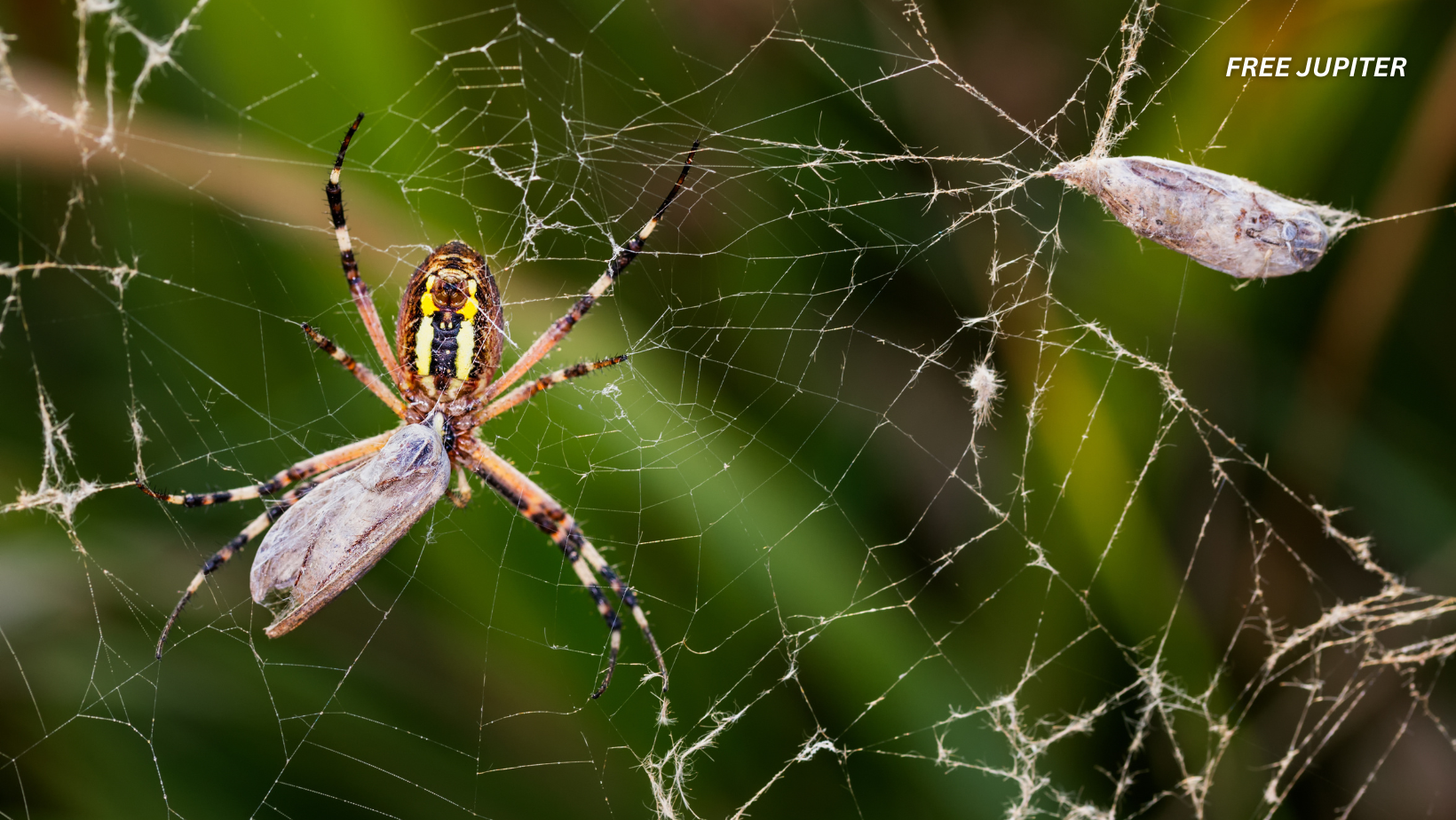
For centuries, spider silk has sparked curiosity. It looks delicate, almost invisible when it catches the light, yet it can stop fast flying insects midair and withstand forces that would snap many man made fibers. Scientists have long known that, pound for pound, spider silk is stronger than steel and tougher than Kevlar. What they did not fully understand was how spiders manage to produce such a powerful material from what begins as a simple liquid inside their bodies.
Now, researchers have uncovered the precise molecular process that allows this transformation to happen. At the center of the discovery is what scientists describe as a molecular handshake between two amino acids. This tiny interaction explains how spiders turn a gooey protein solution into one of the strongest natural materials on Earth. The findings are reshaping material science and even offering clues that could help researchers better understand diseases like Alzheimer’s.
Related article: Scientists Observe Spiders Imprisoning Fireflies as Glowing Bait To Attract More Prey Into Their Webs
From Liquid to Lifeline: How Silk Begins Inside the Spider
Inside a spider’s abdomen are specialized silk glands. Within these glands, silk exists in a thick liquid state made of long protein chains. These proteins float in a dense solution that resembles syrup more than thread. At this stage, there is nothing obviously strong about it.
The transformation happens as the spider pulls the liquid through narrow tubes called spinnerets. As the material travels through these tiny channels, it experiences changes in pressure, acidity, and mechanical force. These shifts act like signals, telling the proteins it is time to rearrange themselves.
Within moments, the loose and disordered protein chains begin to align and connect. What exits the spinnerets is no longer liquid. It is a solid fiber that can stretch without snapping and absorb tremendous energy before breaking. The speed of this process has puzzled scientists for decades. How does such a dramatic change occur so quickly and reliably?
The Molecular Handshake That Changes Everything
The answer lies in two specific amino acids, arginine and tyrosine. Amino acids are the building blocks of proteins. When certain amino acids interact, they can create bonds that influence how proteins fold and assemble.
In spider silk, arginine and tyrosine form a temporary but powerful connection. Scientists refer to this interaction as a molecular handshake. When the spider pulls on the silk, the stretching force encourages these amino acids to snap together. Once they connect, they trigger a rapid phase separation.
Phase separation is a process in which a mixture divides into distinct regions with different properties. A familiar example would be oil separating from water. In the case of spider silk, the once uniform protein solution reorganizes into tightly packed structures. The proteins stack in an orderly fashion, creating strong crystalline regions embedded within more flexible sections.
This combination of rigid and stretchy components gives silk its remarkable toughness. It is not just strong. It is resilient. It can deform under stress and then return to its original shape without breaking. The molecular handshake ensures that the protein chains lock into place at exactly the right time, forming a stable yet flexible fiber.
Why Spider Silk Outperforms Steel by Weight
When people hear that spider silk is stronger than steel, it can sound exaggerated. In reality, the comparison is based on weight. If you compare fibers of equal thickness, silk can withstand more force before breaking than many types of steel.
The secret is not density but structure. Steel relies on tightly packed metal atoms arranged in a rigid lattice. Spider silk, by contrast, achieves strength through protein architecture. The crystalline regions formed by organized protein chains act like reinforcing beams. The surrounding flexible regions act like shock absorbers.
This balance allows silk to handle sudden impacts without shattering. It distributes force evenly along the strand. That is why a web can stop a fast moving insect without tearing apart. The energy is absorbed and spread across multiple fibers, each one contributing to the web’s overall integrity.
A Blueprint for Sustainable Engineering
One of the most exciting aspects of this discovery is its potential for sustainable manufacturing. Spider silk is biodegradable and produced at room temperature using natural processes. It does not require high heat, toxic chemicals, or energy intensive equipment.
Modern industries are searching for materials that are lightweight, durable, and environmentally friendly. If scientists can replicate the molecular handshake that gives silk its strength, it could lead to advanced textiles, flexible body armor, medical sutures, and even lightweight components for aircraft and spacecraft.
Several research groups are already experimenting with synthetic spider silk made from engineered bacteria or yeast. The challenge has always been recreating the precise conditions that allow proteins to organize correctly. With a clearer understanding of how arginine and tyrosine interactions trigger phase separation, researchers now have a more accurate map to follow.
Related article:Scientists Say We May Be Wrong About Where Spiders Came From
Lessons for Medicine: Understanding Protein Clumping
The implications extend beyond engineering. The way silk proteins gather and organize has surprising similarities to what happens in certain neurodegenerative diseases.
In Alzheimer’s disease, for example, proteins in the brain misfold and clump together. These clumps form plaques that disrupt communication between nerve cells. Over time, this leads to memory loss and cognitive decline.
Spider silk also involves protein clumping, but in a controlled and beneficial way. The proteins assemble into structured fibers instead of forming harmful aggregates. By studying how spiders manage this delicate balance, scientists may uncover strategies to guide or prevent unwanted protein aggregation in the human body.
In simple terms, spiders seem to have mastered a process that humans are still trying to understand. Their silk proteins know how to gather without becoming destructive. That insight could one day inform therapies aimed at protecting brain health.
Nature as a Master Engineer
The deeper scientists look into spider silk, the more they appreciate its elegance. Spiders do not rely on complex machinery. They rely on chemistry and physics working together in harmony. Their silk glands fine tune conditions so that molecular interactions occur at the perfect moment.
This discovery reinforces a broader idea in science. Nature often solves problems with efficiency and precision that human technology struggles to match. Instead of forcing materials into shape with brute strength, biological systems guide molecules into place through subtle changes in environment and timing.
By learning from these systems, researchers can design smarter materials that assemble themselves under the right conditions. The goal is not to copy spiders exactly but to apply their principles in new contexts.
The Road Ahead for Spider Silk Research
Although the molecular handshake has been identified, there is still much to explore. Scientists want to understand how different species of spiders produce silks with varying properties. Some silks are designed for catching prey, others for wrapping food, and still others for building egg sacs. Each type has unique mechanical traits.
Understanding these variations could open the door to custom designed materials tailored for specific uses. It may also reveal additional molecular interactions that fine tune strength, elasticity, or durability.
Researchers are also studying how environmental factors such as humidity and temperature influence silk formation. These details matter when attempting to manufacture synthetic silk on a large scale.
Related article: Scientists Uncover Hundreds of Promising Antibiotic Candidates in Snake and Spider Venom
The Bigger Picture
Spider silk is more than a biological curiosity. It represents a bridge between disciplines. Chemistry, physics, biology, engineering, and medicine all intersect in a single strand of web.
The discovery of the molecular handshake between arginine and tyrosine does more than solve a long standing mystery. It provides a framework for innovation. It shows that extraordinary strength can arise from tiny interactions, and that organization at the molecular level determines performance at the human scale.
What begins as a sticky liquid inside a spider becomes a fiber capable of extraordinary feats. That transformation is not magic. It is chemistry guided by evolution and refined over millions of years.
As scientists continue to unravel the secrets of spider silk, they are not only learning why it is stronger than steel. They are learning how small connections can lead to powerful results. And in that lesson, there is inspiration for the future of materials science, sustainable technology, and even the protection of the human brain.
Featured image: Freepik.
Friendly Note: FreeJupiter.com shares general information for curious minds. Please fact-check all claims and double-check health info with a qualified professional. 🌱