
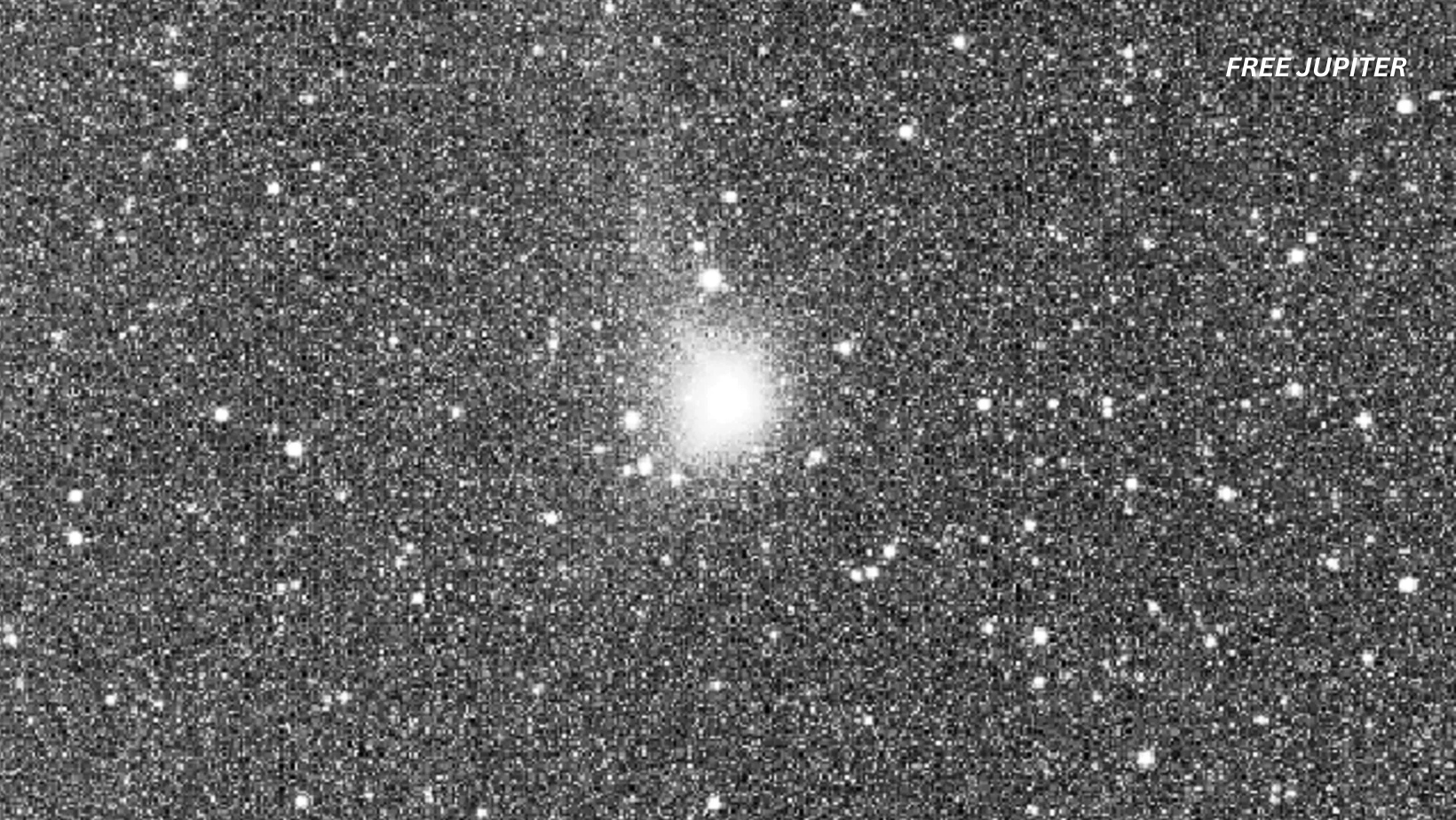
A strange comet from far beyond our solar system is putting on quite a show—one so unusual that astronomers are rethinking what they thought comets were capable of. The object in question is 3I/ATLAS, an icy traveler that came drifting into our neighborhood earlier this year. And according to a new scientific analysis, its surface may be experiencing bursts of activity that look suspiciously like ice volcanoes.
Yes, volcanoes made of ice. As if space wasn’t weird enough already.
This new suggestion comes from a team of researchers who have been keeping a close eye on 3I/ATLAS since its discovery. Their work builds on earlier findings that hinted the comet might contain surprising amounts of metal, something not usually seen in typical comets that orbit our Sun. All these clues, taken together, have pushed scientists to rethink how comets form—not just here, but in other planetary systems across the galaxy.
A Visitor From Far Beyond the Solar System
When astronomers spotted 3I/ATLAS in July, they immediately knew it wasn’t a typical comet. It arrived from interstellar space, meaning it formed around another star entirely. Objects like these come in fast, sweep through our solar system once, and then disappear back into the dark. Because of their rarity, every bit of information scientists can gather from them is precious.
What makes interstellar comets so interesting is their “pristine” condition. Unlike comets that orbit the Sun repeatedly and get cooked, cracked, and reshaped over and over, an interstellar comet can remain nearly unchanged for billions of years. Examining one is a bit like getting a sample from the deep freezer of the early universe.
And 3I/ATLAS has been full of surprises.
Read more: Scientists Find a Fungus That Literally Uses Radiation as Food
A Sudden Brightening That Didn’t Behave Like Normal Comets
A recent study led by Josep M. Trigo-Rodríguez, Maria Gritsevich, and Jürgen Blum revealed something extraordinary: as 3I/ATLAS approached about 2.5 times the distance between the Earth and the Sun, it suddenly grew dramatically brighter. Comets often brighten as they warm up, but this one didn’t fade quickly afterward. Instead, it stayed unusually active.
This told astronomers that something powerful had been triggered beneath its surface. Normally, sunlight warms a comet and causes frozen water to evaporate, but the behavior of 3I/ATLAS suggested something more dramatic was going on—something capable of producing a sustained blast of energy.
That’s where the idea of ice volcanoes, or cryovolcanism, enters the picture.
What on Earth (or rather, what in space) Is Cryovolcanism?
Cryovolcanism is a type of eruption powered not by molten rock, but by frozen materials such as water, nitrogen, or methane. When these ices heat up and turn into gas, they can erupt through the surface in explosive plumes.
Think of it as a volcano having a snow day.
We’ve already seen this type of activity elsewhere. Saturn’s moon Enceladus famously shoots enormous plumes of icy water into space, and those bursts are believed to come from internal cryovolcanic processes. So the concept isn’t new—just unexpected on a tiny interstellar comet.
According to the new study, 3I/ATLAS might lack the dark, dusty outer layer that solar system comets usually develop over time. Instead, it may be covered in exposed ice. If that ice suddenly heated up as it moved closer to the Sun, massive eruptions could easily follow.
Imagine patches of the comet’s surface suddenly cracking open and blasting out jets of vapor and particles. That’s what scientists suspect happened.
A Metal-Rich Mystery Hidden in the Comet’s Core
The surprises didn’t end there. When the researchers studied how the comet reflected light, they found something unexpected: its spectrum matched a rare type of meteorite called carbonaceous chondrite (specifically the CR group). These meteorites are some of the oldest material in the solar system, and they’re known for having high amounts of metals like iron and nickel.
If 3I/ATLAS is made of similar material, that means it’s much more metal-rich than most comets observed near us.
Why does this matter? Because those metals could play a direct role in how the comet behaves.
When 3I/ATLAS warmed up, liquid water might have formed inside it. That water, in contact with tiny metal grains, could trigger chemical reactions—essentially a kind of slow corrosion. As this happens, gases such as carbon dioxide could be released. Combine those gases with the heating ice near the surface, and you get exactly the kind of internal pressure needed to drive ongoing cryovolcanic eruptions.
In other words, the comet might be fueling its own explosions from the inside out.
Read more: These “Toxic” Shampoo Ingredients Are Far More Dangerous Than You Realize
What This Means for How Comets Form Elsewhere
For decades, scientists thought most comets were simple mixtures of dust, rock, and frozen materials. Metal content was expected to be low, especially in cometary bodies. But 3I/ATLAS is challenging that assumption.
If interstellar comets can form with high metal content, unique chemical mixtures, or unusual surface conditions, it suggests that planetary systems elsewhere in the universe might produce comets very different from our own.
This opens the door to an exciting possibility:
the rules for building planets and comets might vary dramatically from one star system to another.
And we’ve barely begun to sample what’s out there.
Read more: Just Two Cigarettes a Day May Raise Heart Failure Risk by 50%, New Research Finds
A Rare Glimpse Into the Deep Past of a Distant Star System
Astronomers have only confirmed three interstellar objects so far, and just two of them behaved like comets. Each new one is an opportunity to learn not just about these visitors themselves, but about the star systems that tossed them into space long ago.
Every burst of light from 3I/ATLAS, every unusual spectrum, and every sign of cryovolcanic activity is a clue. Together, they paint a picture of a comet that is ancient, metal-rich, and possibly still undergoing chemical changes as sunlight wakes up the frozen materials within it.
As technology improves and sky surveys continue, more interstellar objects will undoubtedly be discovered. And with each one, we’ll get a clearer sense of how diverse, complicated, and downright strange the universe’s small icy bodies can be.
The recent study detailing these findings—titled “Spectrophotometric evidence for a metal-bearing, carbonaceous, and pristine interstellar comet 3I/ATLAS”—was shared on the arXiv preprint server on November 24, 2025.
Featured Image credit: ESA/Juice/NavCam
Friendly Note: FreeJupiter.com shares general information for curious minds. Please fact-check all claims and double-check health info with a qualified professional. 🌱