

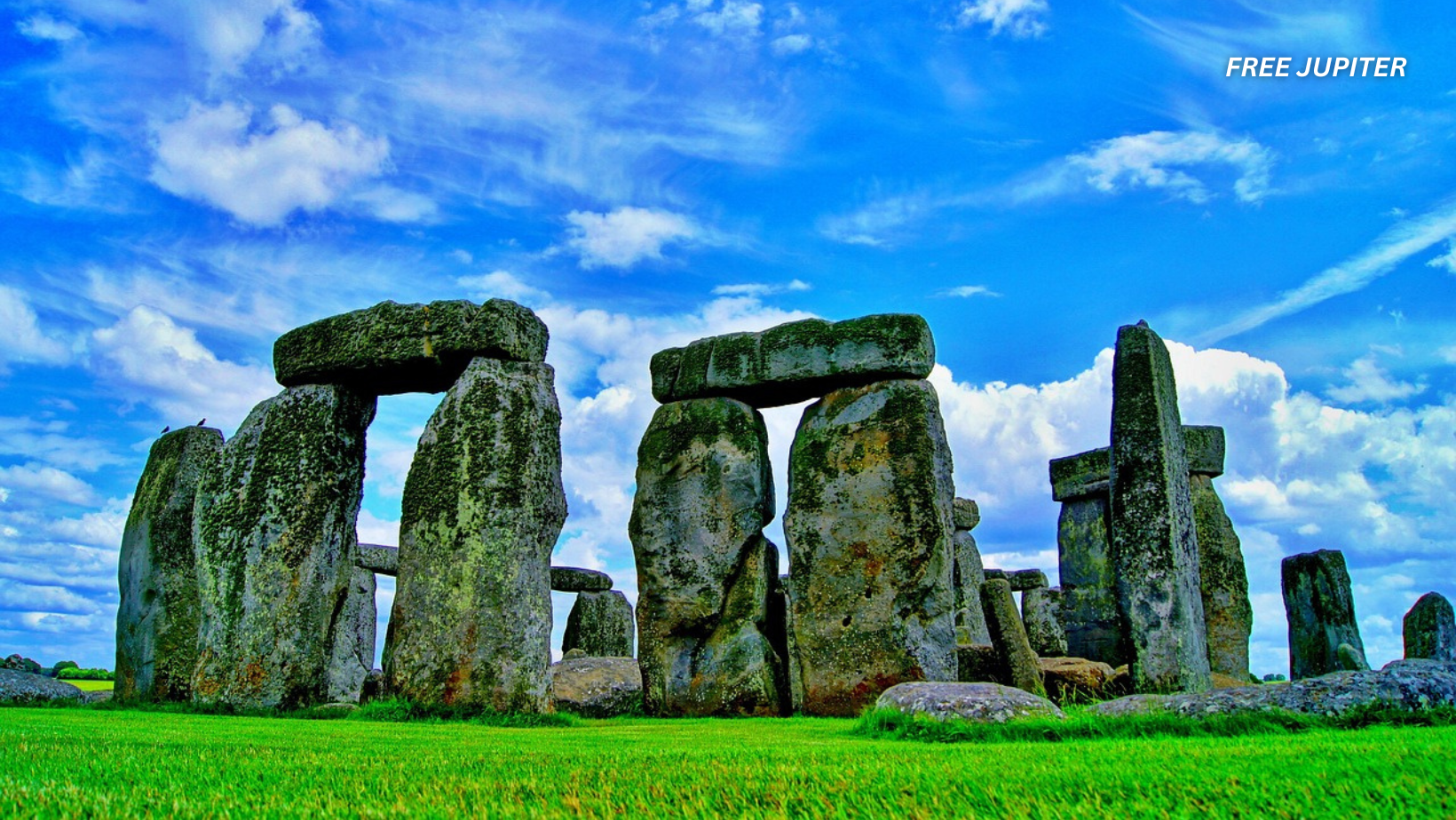
Stonehenge has stood on the open plains of southern England for more than four thousand years, long before written history, long before modern tools, and long before the idea of scientific investigation existed. Despite centuries of study, the monument continues to resist simple explanations. Every generation seems to uncover a new layer of complexity, reminding us that the past is often far more sophisticated than it first appears.
Among the many questions surrounding Stonehenge, one has quietly lingered at the center of debate. How did ancient people move stones weighing up to twenty five tonnes across vast distances to create a monument so carefully arranged and enduring?
A new scientific study is now offering one of the most convincing answers yet. According to researchers from Curtin University, the massive stones at Stonehenge were almost certainly transported by human effort rather than by natural forces such as glaciers. This conclusion reshapes not only how the stones arrived but also how we understand the people who built the monument in the first place.
Related article: Discovery Under Bermuda Reveals A ‘Structure’ Unlike Any Known On Earth
The Stones That Did Not Belong There
Stonehenge is not made from a single type of rock. While some of its larger stones come from relatively nearby sources, others, known as bluestones, originated far beyond Salisbury Plain. These bluestones have long puzzled researchers because their geological fingerprints point to regions in Wales and even as far north as Scotland.
Transporting stones over such distances would have required an extraordinary commitment of time, labor, and planning. This challenge led some researchers to propose a simpler explanation. Perhaps nature did the heavy lifting.
The glacier theory suggested that during the last Ice Age, massive sheets of ice moved slowly across Britain, carrying rocks with them like cargo frozen into motion. As the ice melted, it could have deposited stones along its path, leaving ancient builders to work with whatever materials happened to be nearby.
For years, this idea remained attractive because it reduced the need to imagine complex prehistoric engineering. However, it also relied heavily on assumptions rather than direct evidence.
Turning to the Landscape for Answers
To test whether glaciers truly reached the Stonehenge area, researchers needed to look beyond the monument itself. Instead, they examined the surrounding environment, searching for geological clues hidden in plain sight.
The team focused on river sediments found near Stonehenge. Rivers act as natural collectors, gathering particles eroded from rocks across entire landscapes. Over thousands of years, these sediments accumulate tiny mineral grains that preserve information about where they came from and how they traveled.
If glaciers had once swept through the region, they would have scraped rocks from distant areas and scattered their mineral remnants across southern England. Even after long periods of erosion, those minerals should still be detectable today.
This is where mineral fingerprinting comes into play.
Reading Earth’s Deep Memory
Mineral fingerprinting allows scientists to identify the origin and age of microscopic mineral grains. Among the most valuable of these minerals is zircon, a crystal so durable that it can survive billions of years of geological change.
At Curtin University’s John de Laeter Centre, researchers analyzed more than five hundred zircon crystals collected from river sands near Stonehenge. Each crystal was examined using advanced instruments capable of revealing its age and chemical structure.
These details act like a passport stamp, recording where the crystal formed and the journey it has taken since.
The expectation was clear. If glaciers had transported stones from Wales or Scotland into southern England, the surrounding sediments would contain zircon crystals matching those distant regions.
They did not.
Related article: New Discovery Suggests a Comet Explosion Altered The Earth 12,800 Years Ago
What the Absence of Evidence Reveals
Lead researcher Dr Anthony Clarke explains that the lack of glacial mineral signatures is highly significant. If ice sheets had passed through Salisbury Plain, they would have left behind a clear and unmistakable trail of minerals eroded from faraway landscapes.
Over thousands of years, those rocks would have broken down naturally, releasing zircon grains into rivers and soils. The fact that none of these grains were found strongly suggests that glaciers never reached the Stonehenge site.
In geological terms, silence can speak volumes. The absence of glacial evidence makes the glacier transport theory increasingly difficult to support.
This leaves one explanation standing.
Humans moved the stones.
Reimagining Ancient Capability
Accepting human transport as the most likely explanation forces a shift in perspective. Rather than viewing Neolithic people as passive recipients of nature’s leftovers, the evidence suggests they were deliberate planners capable of organizing massive construction projects.
Moving stones weighing several tonnes over long distances would have required careful coordination. Communities would have needed to work together, possibly across generations, sharing knowledge and labor in pursuit of a shared goal.
How exactly they did it remains uncertain. Some theories suggest stones were transported by water, floated along rivers or coastlines on wooden platforms. Others propose overland journeys using logs, sleds, ropes, and sheer persistence.
It is also possible that different methods were used depending on terrain and distance. What matters most is not the precise technique, but the intention behind the act.
Stonehenge was not built by chance.
A Monument Built With Meaning
This growing body of evidence aligns with earlier research identifying a Scottish origin for Stonehenge’s central Altar Stone. That discovery alone suggested long distance transport far beyond what would be expected if builders simply used nearby materials.
Taken together, these findings paint a picture of a monument created through choice, effort, and cultural significance.
Stonehenge was likely not a single purpose structure. Archaeological evidence suggests it may have served many roles over time, functioning as a ceremonial site, a gathering place, a marker of seasons, or a location tied to ancestral memory.
Its builders invested enormous effort into its construction, which strongly implies that the monument held deep meaning within their society.
Why These Discoveries Matter Today
According to study co author Professor Chris Kirkland, modern scientific tools are finally allowing researchers to test long held ideas that once relied mainly on speculation.
By studying minerals smaller than grains of sand, scientists can now answer questions that once seemed permanently out of reach. These techniques are not only refining our understanding of Stonehenge but also changing how we interpret prehistoric human capability more broadly.
Rather than viewing ancient societies as technologically limited, research like this highlights their ingenuity, resilience, and ability to work collectively on ambitious projects.
Related article: Scientists Create Light From Complete Darkness in Groundbreaking Discovery
Stonehenge as a Living Question
Despite these advances, Stonehenge continues to resist final answers. Every solved mystery seems to open new questions. Why were these particular stones chosen? Why was this location so important? What beliefs motivated such effort?
What is becoming increasingly clear is that Stonehenge was not an accidental monument shaped by chance geology. It was a deliberate construction shaped by human hands, human minds, and human purpose.
As science continues to evolve, Stonehenge remains a reminder that the past is not silent. Its story is written not only in stone, but in the smallest minerals beneath our feet, waiting patiently to be read.
Featured image: Pixabay.
Friendly Note: FreeJupiter.com shares general information for curious minds. Please fact-check all claims and double-check health info with a qualified professional. 🌱