

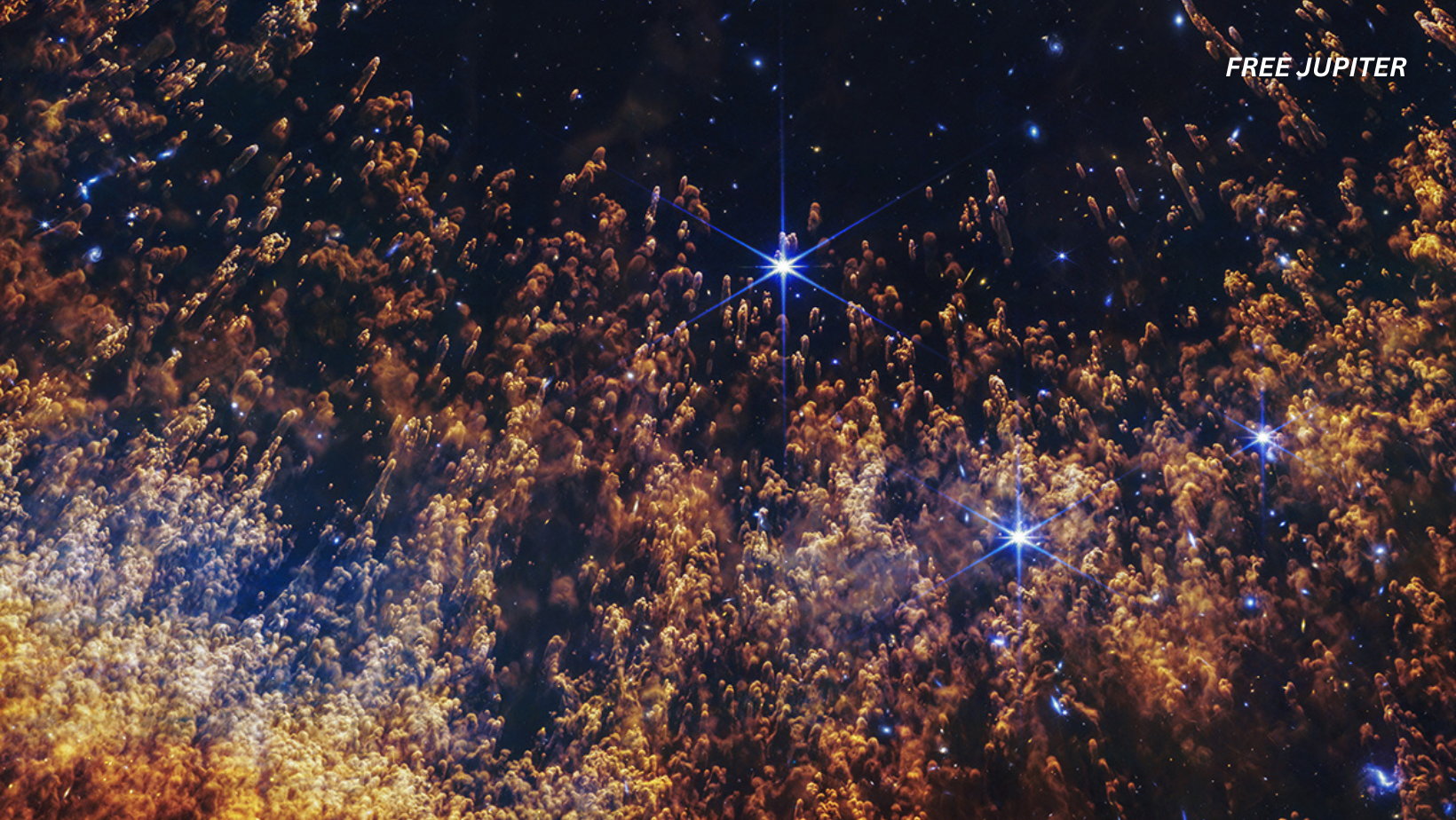
When the James Webb Space Telescope focused its attention on the Helix Nebula, astronomers knew they were revisiting familiar territory. This glowing structure has been photographed many times before and is one of the most recognizable objects in the night sky. Yet the image delivered by Webb felt entirely different. Instead of simply refining what scientists already knew, it reshaped their understanding of a celestial object long considered well explored.
Nicknamed the Eye of God because of its round, glowing appearance, the Helix Nebula has an almost symbolic presence in astronomy. Its shape is striking and strangely expressive, giving the impression of a cosmic observer suspended in space. Webb’s infrared vision, however, revealed that beneath this calm and symmetrical look lies a complex and active environment shaped by a star’s final transformation.
Located about 650 light years away in the constellation Aquarius, the Helix Nebula appears relatively close by cosmic standards. This proximity allows scientists to study it in remarkable detail, making it an ideal subject for Webb’s powerful instruments. What the telescope uncovered was not just beauty, but a deeper chemical story tied to how stars live, die, and quietly seed the universe with the ingredients needed for life.
Related article: Physicists Have Just Predicted When the Universe Will ‘End’
The Quiet End of a Sun Like Star
The Helix Nebula is the result of a star reaching the end of its long life. For billions of years, that star burned hydrogen in its core, producing the energy that kept it stable. This balance between outward pressure and inward gravity allowed the star to shine steadily, much like our own sun does today. Eventually, however, the hydrogen supply ran low. When that happened, the star could no longer sustain the reactions that held it together.
As the core began to collapse, the outer layers of the star were pushed outward and released into space. These layers formed an expanding cloud of gas and dust, slowly drifting away from the center. What remained behind was a white dwarf, an incredibly dense stellar remnant roughly the size of Earth but containing much of the star’s original mass.
White dwarfs no longer generate energy through fusion, but they remain extremely hot for a long time. Their heat causes the surrounding gas to glow, creating the luminous appearance of a planetary nebula. Despite the name, planetary nebulae have nothing to do with planets. The term dates back to early astronomy, when their rounded shapes resembled planets through small telescopes. Today, they are understood as a natural stage in the life cycle of many stars throughout the galaxy.
Webb’s Infrared Vision Changes the Story
What sets the James Webb Space Telescope apart from earlier observatories is its ability to see infrared light. This allows it to peer through thick clouds of dust that block visible light, revealing structures and chemical processes that were previously hidden. In the Helix Nebula, this capability exposed fine filaments, layered shells, and dense knots of material scattered throughout the glowing ring.
More importantly, Webb detected complex molecules embedded within the nebula’s dust. These molecules include carbon rich compounds that are considered essential building blocks for life. Their presence in such a harsh environment surprised scientists and raised new questions about how organic material forms and survives in space.
The nebula is not a quiet graveyard. It is an active chemical environment where radiation, heat, and matter interact continuously. Webb’s data suggest that even after a star dies, its surrounding material remains chemically productive. This challenges older ideas that saw planetary nebulae as brief and simple phases, instead revealing them as dynamic contributors to the galaxy’s chemical evolution.
Related article: Scientists Detect Unusual Gravitational Wave That May Indicate a Wormhole Connecting Universes
The Ingredients of Life Travel Through Space
One of the most intriguing aspects of Webb’s observations is what they imply about the spread of life friendly materials across the universe. The molecules detected in the Helix Nebula do not remain trapped there forever. Over time, they drift outward and mix with the interstellar medium, the vast and thin cloud of gas and dust that fills the space between stars.
Eventually, parts of this material may collapse to form new stars and planetary systems. When that happens, the recycled elements from long dead stars become part of new worlds. In this way, planetary nebulae act as bridges between generations of stars, passing along carbon, oxygen, and other essential elements.
This idea supports a growing view in astronomy that the ingredients for life are not rare or isolated. Instead, they are produced repeatedly and distributed widely as stars form and die. Life, in this sense, may be built from ancient materials that have traveled across space for billions of years before becoming part of living systems.
Connections to Other Webb Discoveries
The Helix Nebula is only one piece of a much larger puzzle emerging from the James Webb Space Telescope’s early discoveries. In star forming regions such as the Orion Nebula, Webb has detected dense clouds filled with water vapor and organic molecules. These regions are actively giving birth to new stars, showing that complex chemistry is present even at the earliest stages of stellar formation.
Webb has also studied protoplanetary disks, the swirling rings of dust and gas that surround young stars and eventually form planets. In several of these disks, the telescope identified chemical signatures similar to those found in older nebulae. This suggests a continuity in cosmic chemistry, linking dying stars to newborn planetary systems.
Together, these observations paint a picture of a universe that constantly recycles material. Stars are not isolated events but part of a long chain of transformation. Each generation inherits the chemical legacy of those that came before, creating conditions that may favor the emergence of life wherever circumstances allow.
Related article: Almost the Entire Universe Is Invisible to Us
Why the Eye of God Still Matters
The Helix Nebula has been photographed countless times, yet Webb’s image proves that familiar objects can still surprise us. With each improvement in technology, layers of the universe that once seemed settled become newly mysterious. The Eye of God, once admired mainly for its appearance, now stands as a key example of how stellar death contributes to cosmic life.
Its glowing rings remind scientists that endings in space are rarely final. Instead, they are transitions, reshaping matter and redistributing energy in ways that sustain the universe’s ongoing creativity. Through the lens of the James Webb Space Telescope, the Helix Nebula is no longer just a striking image. It is evidence that the universe is quietly generous, passing along the raw materials needed for future worlds long after a star’s light has faded.
(Image credit: NASA, ESA, CSA, STScI, A. Pagan (STScI))
Friendly Note: FreeJupiter.com shares general information for curious minds. Please fact-check all claims and double-check health info with a qualified professional. 🌱