
Mars is famous today for its dusty red deserts, rocky landscapes, and massive canyons, but this barren appearance hides a watery past. Evidence is mounting that billions of years ago, the red planet was once blue, covered with lakes, rivers, and even oceans. Recent research has not only confirmed that Mars had vast bodies of water but has also estimated just how high these waters once stood during the planet’s wettest periods.
For decades, scientists have speculated that Mars may have been a world filled with liquid water. From river-like valleys to mineral deposits that only form in the presence of water, clues are scattered across the Martian surface. The new study takes this speculation a step further, combining satellite data with geological modeling to paint the most vivid picture yet of Mars’ aquatic history.
Exploring Coprates Chasma: A Window into Mars’ Past
The research team, based in Italy and Switzerland, focused on Coprates Chasma, a massive canyon within the Valles Marineris system. Valles Marineris is the largest canyon network in the Solar System, stretching over 4,000 kilometers, nearly the width of Europe. Within this colossal landscape, Coprates Chasma revealed geological formations that immediately caught the scientists’ attention: fan-shaped deposits that strongly resemble river deltas found on Earth.
On our planet, deltas form when rivers meet standing bodies of water, such as lakes or oceans. As the river slows, it deposits sediments that spread out in branching, fan-like patterns. Identifying these structures on Mars provides a direct clue that liquid water once flowed across the planet’s surface and collected in vast basins.
“Delta structures develop where rivers flow into oceans, as we know from numerous examples on Earth,” explains Fritz Schlunegger, a geomorphologist at the University of Bern in Switzerland. “The features we identified in these satellite images clearly mark the points where rivers would have emptied into an ocean.”
Related article: Carl Sagan Left a Beautiful Message for the First Humans To Arrive on Mars
Measuring Ancient Martian Seas
The scientists used elevation data to estimate the size and depth of the ancient ocean. The delta formations were located at elevations between 3,650 and 3,750 meters below the Martian reference surface. This puts them about 1,000 meters above the deepest point in Valles Marineris, which is roughly comparable to the depth of some of Earth’s ocean trenches.
Based on these measurements, the ancient Martian ocean would have covered a significant portion of the northern hemisphere, roughly the size of Earth’s Arctic Ocean. “This is the deepest and largest former ocean we’ve found on Mars so far,” says Ignatius Argadestya, a geologist at the University of Bern. “It stretched across much of the northern hemisphere, fed by rivers and streams from surrounding highlands.”
This is a significant discovery because it provides a reference point for Mars’ water level during its wettest period. Scientists can now better understand how much water once existed on the planet and how it shaped the surface we see today.
A Timeline for Mars’ Watery Era
Using sediment analysis and geological modeling, researchers estimate that these deposits formed around three billion years ago. This suggests that this period represents the peak of surface water availability on Mars. Interestingly, this is slightly later than earlier estimates for when oceans existed, meaning Mars may have remained wetter for longer than previously believed.
The presence of these delta structures indicates a slow but steady flow of water, suggesting that Mars once had a climate capable of sustaining liquid water for extended periods. This kind of stable environment is crucial for the possibility of life, as it allows chemical reactions and ecosystems to develop over millions of years.
The Implications for Life on Mars
Mars’ watery past raises an exciting question: could life have existed there? Life appeared relatively quickly on Earth once conditions were favorable, so it is conceivable that similar early life forms may have briefly thrived on Mars. Microbial organisms could have inhabited lakes, rivers, and shallow ocean regions, feeding on chemical nutrients and perhaps leaving behind subtle traces in the planet’s rocks.
Scientists have long searched for signs of ancient Martian life, from fossilized microbial mats to chemical signatures in sediments. While no direct evidence has yet been found, the discovery of an extensive northern ocean makes the planet’s habitability much more plausible. A stable ocean, fed by rivers, would have created a relatively warm and chemically diverse environment, one of the few in the Solar System capable of supporting life as we know it.
Related article: Huge Chunks of Ancient Space Objects Could Be Buried Inside Mars
How the Water Disappeared
So what happened to all this water? Scientists believe that over hundreds of millions of years, much of Mars’ water either evaporated into space or sank beneath the surface. Unlike Earth, Mars lost much of its atmosphere, which made it difficult to retain liquid water on the surface. Without a thick atmosphere and magnetic field to shield it from the Sun’s radiation, water gradually disappeared, leaving behind the dry, dusty landscape we see today.
Some of this water may still exist underground in the form of ice or briny liquid, especially near the poles. Recent missions have detected layers of ice beneath the surface and in some craters, suggesting that while Mars is no longer blue, its watery past has left hidden traces.
Why This Discovery Matters
Understanding Mars’ watery past is more than an academic exercise. It helps scientists learn how planets evolve over time, how climates change, and what conditions are necessary for life to emerge. Comparing Mars with Earth also provides insight into our own planet’s history, showing how water shapes landscapes, climates, and ecosystems.
This discovery also guides future exploration missions. NASA’s Perseverance rover and the European Space Agency’s ExoMars mission are both focused on searching for signs of ancient life, and knowing where to look—ancient deltas, lakebeds, and coastlines—can dramatically increase the chances of finding something meaningful.
Furthermore, the ancient ocean and river systems highlight the complexity of Mars’ geology. The fact that rivers could flow for millions of years and form stable deltas indicates that the planet’s interior was once geologically active, with enough heat and volcanic activity to support a hydrological cycle similar to Earth’s.
A Planet of Contrasts
Today, Mars appears inhospitable: frozen poles, dry valleys, and a thin atmosphere. But its past tells a very different story. For a fleeting moment in cosmic time, Mars may have been a vibrant, water-rich world, with rivers carving valleys, lakes shimmering in sunlight, and oceans stretching across continents. It was a world that may have been surprisingly familiar to an Earth observer, hinting that life could have had a chance to develop.
Even as we explore the Martian surface, these discoveries remind us that planets can change dramatically over time. What is barren today may once have been lush and alive. And by studying these changes, scientists hope to answer some of humanity’s biggest questions: Are we alone in the universe? Could life exist elsewhere? And what does Mars’ story tell us about the future of our own planet?
Related article: NASA Confirms Mars’ Core Is Solid, Not Molten
Looking Ahead
With new missions arriving and advanced satellite imagery improving our view of Mars, the story of the red planet’s watery past is far from complete. Future discoveries may reveal more about the extent of oceans, the duration of wet periods, and even the chemical conditions that could have supported life.
One thing is clear: Mars was not always the dry, dusty world we see today. Its blue past, marked by rivers, lakes, and oceans, opens a window into a time when the planet was alive with water and potential. And as scientists continue to uncover these secrets, we may get closer than ever to understanding not just Mars’ history, but the story of life in our Solar System.
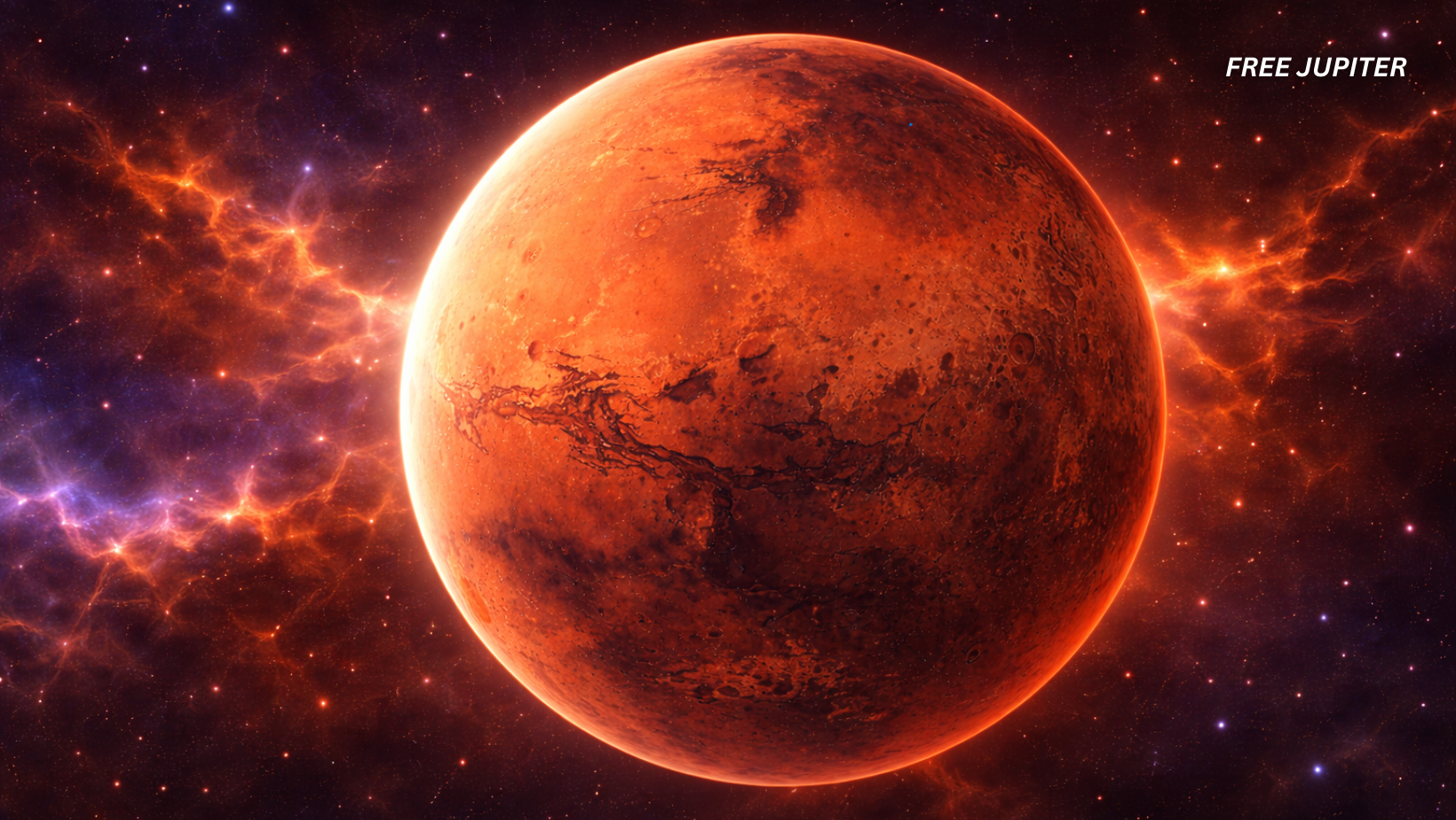
Featured image: GPT Creation.
Friendly Note: FreeJupiter.com shares general information for curious minds. Please fact-check all claims and double-check health info with a qualified professional. 🌱