
The universe has a long memory. Every flash of light, every burst of energy, and every dying star leaves behind a trace that continues traveling through space long after the moment has passed. In rare cases, those traces survive long enough to reach Earth, carrying stories from a time before our planet even existed. One such story arrived recently in the form of a signal that lasted only ten seconds but took more than 13 billion years to complete its journey.
Scientists describe it as one of the most distant stellar death events ever observed. While the signal itself was brief, the implications are vast. It offers new insight into the early universe, challenges long held assumptions about cosmic evolution, and reveals how time itself stretches and bends across unimaginable distances.
Listening to the Deep Past
When astronomers look into space, they are also looking back in time. Light does not travel instantly. It moves at a fixed speed, and over cosmic distances, even that incredible speed becomes slow. The farther away an object is, the older the light we see from it.
In this case, the light began its journey when the universe was only about 730 million years old. Today, the universe is roughly 13.8 billion years old. That means the event occurred during an era when the first generations of stars and galaxies were still forming.
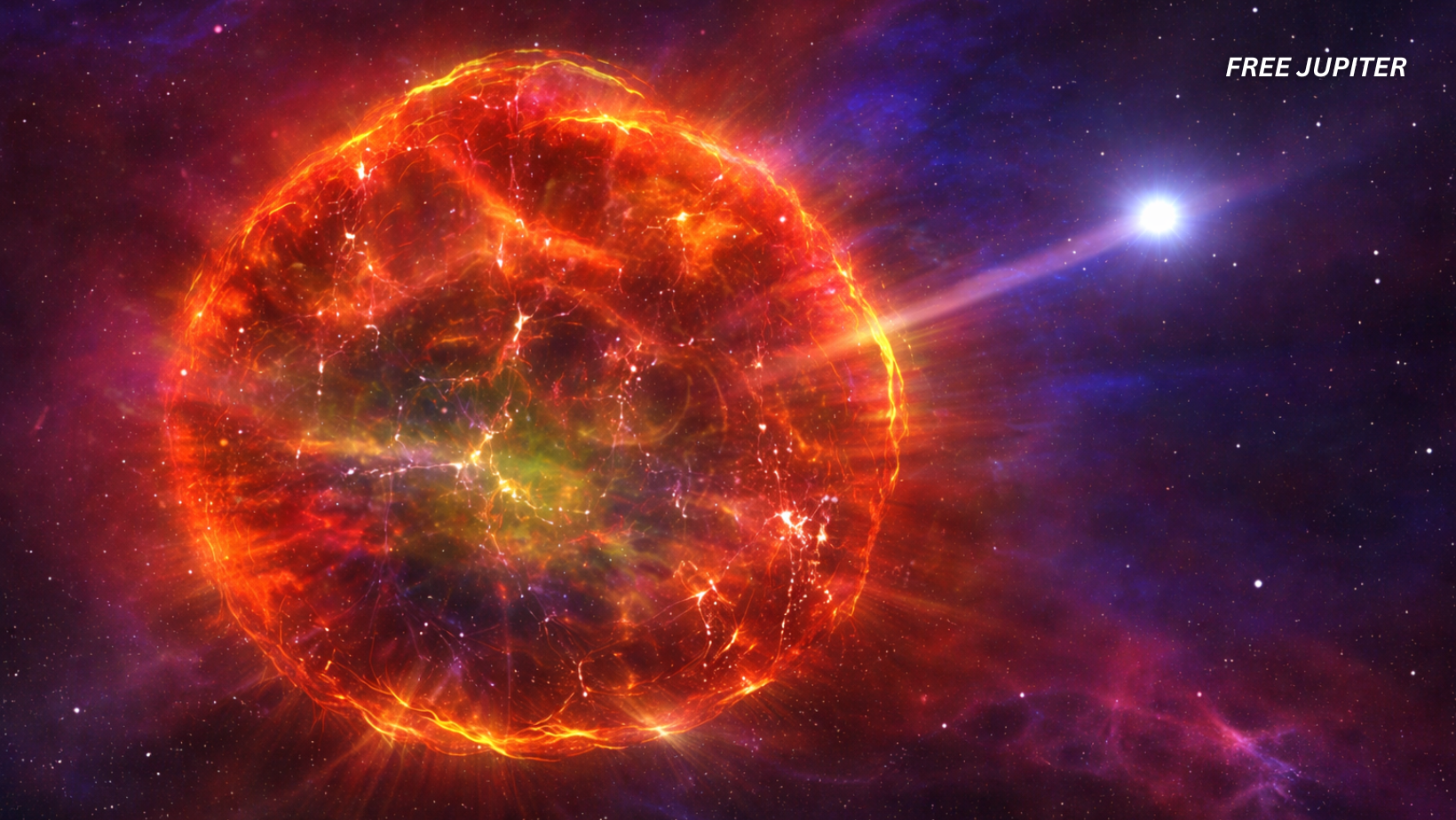
NASA, along with international observatories such as the Nordic Optical Telescope and the Very Large Telescope, worked together to analyze this ancient signal. What initially appeared as a mysterious flash eventually revealed itself as the unmistakable signature of a supernova, the explosive death of a massive star.
Related article: Earth’s Seasons Are Now Oddly Out of Sync, New Space Data Has Revealed
A Star That Lived Fast and Died Young
Supernovae are among the most powerful events in the universe. They occur when massive stars exhaust their fuel and collapse under their own weight. The collapse triggers an enormous explosion that releases vast amounts of light and energy. For a short time, a single dying star can outshine an entire galaxy.
What makes this supernova remarkable is not just its power, but its timing. It occurred during a period when the universe was still emerging from darkness. Before stars existed, the universe was filled with neutral gas that absorbed light. As the first stars formed and died, they began to change that environment, slowly turning the universe transparent.
This particular explosion happened during that transformation. It suggests that massive stars were already forming, evolving, and ending their lives in familiar ways much earlier than scientists once believed.
A Ten Second Signal With a Long Journey
The signal was first detected on March 14, 2025, by a space based satellite designed to monitor sudden cosmic events. The burst lasted only ten seconds. In everyday terms, that is barely enough time to take a breath or glance at a clock. In cosmic terms, however, it was an extraordinarily loud announcement.
This type of event is known as a gamma ray burst. Long gamma ray bursts usually occur when massive stars collapse and form black holes. As the star falls inward, powerful jets of energy shoot outward at nearly the speed of light. If one of those jets happens to point toward Earth, instruments can detect it across billions of light years.
The burst was labeled GRB 250314A, but its significance goes far beyond its technical name. It likely came from one of the earliest generations of stars, born in an environment very different from the one stars experience today.
Was the Early Universe Already Organized?
For many years, scientists believed the early universe was wildly chaotic. According to that view, stars and galaxies needed a long time to settle into stable patterns. This discovery complicates that picture.
The supernova behaved in ways that look surprisingly modern. The physics involved appears familiar, suggesting that the fundamental rules governing stars were already in place just 700 million years after the Big Bang.
This raises an intriguing possibility. If stars were already dying in predictable ways at that time, then the universe may have gone through its most chaotic phase even earlier. That earlier chapter remains largely hidden, beyond the reach of current instruments.
Rather than witnessing the beginning of everything, scientists may be seeing a universe that had already found its rhythm.
Related article: What Space Actually Smells Like, According to Astronauts and Scientists
Time, Stretched and Slowed
One of the most fascinating lessons from this discovery is how it demonstrates the strange behavior of time across cosmic distances. The burst lasted ten seconds at its source. Yet because space itself has been expanding the entire time, those ten seconds were stretched as the signal traveled.
This effect, known as time dilation, means that distant events appear slower and longer when observed from Earth. It is as if the universe pressed pause and allowed scientists to examine a fleeting moment in remarkable detail.
The signal acts like a delayed message, preserved by the vastness of space. While the star died billions of years ago, its final moments are only now being observed. In that sense, the universe functions as its own archive, storing information in light.
Learning From a Stellar Autopsy
By studying this signal, scientists can learn about the internal structure of stars that existed at a time when the universe had fewer heavy elements. Early stars were made mostly of hydrogen and helium, the simplest ingredients left over from the Big Bang.
Despite their simplicity, these stars could grow enormous and burn intensely. Their deaths helped seed the universe with heavier elements, making planets, oceans, and life possible billions of years later.
This supernova provides evidence that the cycle of stellar birth and death was already well underway early on. It shows that the universe did not wait long to begin building complexity.
A Galaxy That May No Longer Exist
The star that produced this signal lived inside a young galaxy that formed shortly after the universe itself. That galaxy may not exist anymore in any recognizable form. Over billions of years, galaxies collide, merge, and change shape. Some are torn apart, while others are absorbed into larger systems.
What scientists are likely seeing is a snapshot of a galaxy frozen in time, revealed only because one of its stars exploded. Without that explosion, the galaxy might remain invisible forever.
This is why researchers sometimes describe such observations as glimpses of ghost galaxies. The light reveals something that once was, but may no longer be.
Related article: First-Ever Recording Captures Black Hole “Kicked” Across Space And Time
Why This Discovery Matters
At first glance, a ten second flash from deep space might seem like a curiosity meant only for astronomers. In reality, it touches on some of the biggest questions humans have ever asked.
How quickly did the universe become structured? When did stars begin shaping space? How much of cosmic history remains hidden from view?
This discovery suggests that the universe was active, organized, and creative earlier than expected. It reminds us that even brief events can leave lasting imprints, traveling across space and time to reach distant observers.
As telescopes become more powerful and detection methods improve, scientists expect to uncover even older signals. Each one will add another layer to our understanding of where everything came from.
For now, this ten second cosmic cry stands as one of the oldest messages ever received on Earth. It is a quiet but profound reminder that the universe has been telling its story for billions of years, and we are only just beginning to listen.
Featured image: Freepik.
Friendly Note: FreeJupiter.com shares general information for curious minds. Please fact-check all claims and double-check health info with a qualified professional. 🌱