
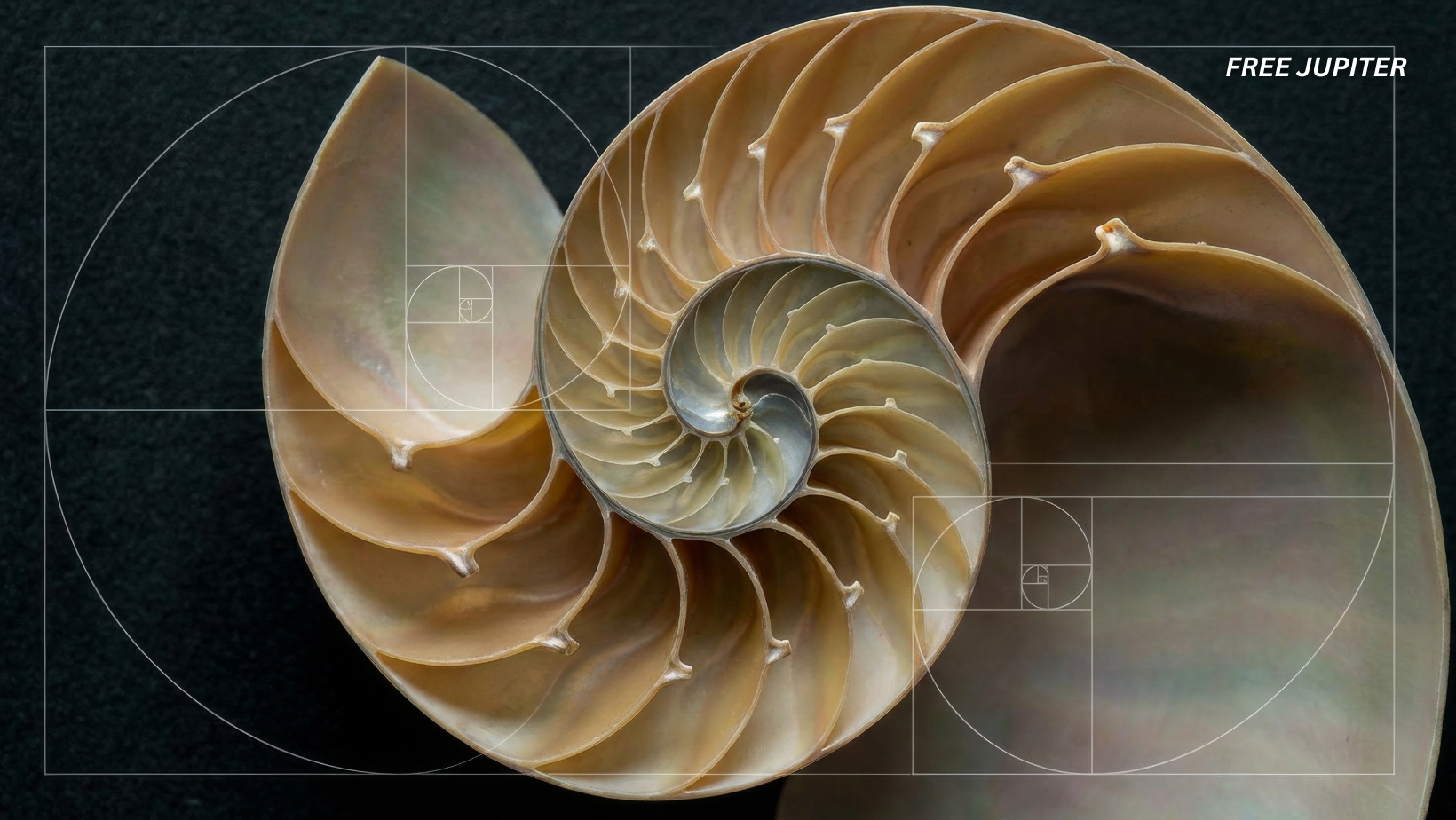
The Fibonacci sequence has fascinated people for centuries. It shows up in places where math and beauty quietly meet, from the spiral of a seashell to the branching of trees and even the proportions of famous works of art. What no one expected was that this ancient number pattern could also help solve one of the most modern and stubborn problems in science.
In a recent experiment, physicists used the Fibonacci sequence to guide how a quantum computer behaves over time. The result was startling. By applying this mathematical rhythm to a system of atoms, researchers created a new and unusually stable phase of matter that allowed fragile quantum information to survive far longer than normal.
This discovery does not just improve performance. It changes how scientists think about time, order, and protection inside quantum systems. It also suggests that some of the best solutions for future technology may come from patterns humanity has known for hundreds of years.
Understanding the Fibonacci Sequence Without the Math Headache
At first glance, the Fibonacci sequence seems almost too simple to matter. Each number is created by adding the two numbers before it. Starting with zero and one, the sequence continues as one, two, three, five, eight, thirteen, and so on.
What makes it special is not the arithmetic itself but the way the sequence grows. It never repeats in a neat cycle. Yet it also never becomes random. Each step depends on what came before it, creating a pattern that is structured but unpredictable.
This quality is why the Fibonacci sequence appears so often in nature. Plants use it to optimize sunlight exposure. Animals display it in shells and horns. Even weather systems can show Fibonacci like spirals. Nature seems to favor patterns that balance order and flexibility, and Fibonacci does exactly that.
Physicists suspected that this same balance might be useful in quantum systems, where too much rigidity leads to failure and too much randomness leads to chaos.
Related article: Your Consciousness Might Be Powered by a Hidden Quantum Field, New Theory Claims
Why Quantum Computers Struggle to Stay Stable
Quantum computers promise incredible power. Unlike classical computers that use bits set to either zero or one, quantum computers use qubits that can exist in multiple states at the same time. This allows quantum machines to explore many possible solutions simultaneously.
The problem is that qubits are extremely delicate. Heat, vibration, electromagnetic noise, and even the act of observation can cause them to collapse into a single state. When that happens, the quantum information is lost.
This fragility is known as decoherence, and it is the biggest obstacle standing between experimental quantum machines and real world applications. Engineers can build qubits. They can manipulate them. But keeping them stable long enough to do useful work has remained painfully difficult.
Most quantum systems lose their information in fractions of a second. Extending that lifespan even slightly is considered a major achievement.
A Small Experiment With Big Consequences
The experiment was carried out by researchers at the Flatiron Institute. Instead of working with a massive quantum computer, they used a carefully controlled system of ten atoms arranged in a straight line. Each atom acted as a qubit.
Laser pulses were used to control how these qubits interacted with each other over time. Normally, these pulses are applied at evenly spaced intervals, like the steady ticking of a clock.
The researchers decided to try something different. They timed the laser pulses according to the Fibonacci sequence. The gaps between pulses followed the same non repeating yet ordered pattern found in the famous number series.
This subtle change produced a dramatic effect. The qubits maintained their quantum state for about 5.5 seconds. In quantum computing terms, that is an eternity. It represents nearly a fourfold improvement over conventional methods.
How a New Phase of Matter Appeared
When particles behave collectively in unusual ways, physicists describe the result as a new phase of matter. We are familiar with phases like solid, liquid, and gas, but quantum physics allows for far stranger possibilities.
In this experiment, the Fibonacci timed pulses created what is known as a temporal quasicrystal. A traditional crystal repeats the same pattern over and over in space. A quasicrystal does not repeat, but it still has a clear structure.
In this case, the pattern unfolded in time rather than physical space. The system never settled into a repeating rhythm, but it also never became disordered. This prevented the buildup of errors that usually destroy quantum information.
The quasicrystal structure acted like an invisible framework that held the system together without locking it into a rigid cycle.
Related article: Scientists Say Human Cells Show Quantum Computer-Like Abilities
Why This Matters Beyond the Laboratory
Although the experiment involved only ten atoms, its implications are far reaching. Stability is one of the main hurdles preventing quantum computers from becoming practical tools.
If this Fibonacci based approach can be applied to larger systems, it could help quantum machines run longer and more reliably without overwhelming error correction overhead.
This would bring scientists closer to using quantum computers for tasks such as designing new drugs, modeling complex chemical reactions, improving battery materials, optimizing logistics, and advancing cryptography.
Each of these applications depends on sustained quantum coherence. Without it, the calculations fall apart before meaningful results appear.
A New Philosophy for Quantum Control
Traditionally, quantum engineers have tried to impose strict order on qubits. They use precise timing, rigid schedules, and repetitive control sequences in an effort to tame quantum behavior.
This experiment suggests a different approach. Instead of forcing order, the researchers allowed structured unpredictability. The Fibonacci sequence provided guidance without repetition, stability without rigidity.
This philosophy aligns closely with how natural systems operate. Many biological and physical processes thrive in patterns that balance order and variation. Quantum systems may benefit from the same principle.
Ancient Math Meets Future Technology
The Fibonacci sequence was described in the early thirteenth century, long before electricity or computers existed. Yet it continues to find new relevance in modern science.
This discovery highlights how old ideas can gain new life when applied creatively. It also shows that progress does not always come from adding complexity. Sometimes it comes from choosing the right pattern.
By drawing inspiration from nature and mathematics, scientists unlocked a new way to protect quantum information.
Related article: Birds Can Actually See Earth’s Magnetic Field—Thanks to Quantum Physics
What Comes Next for Quantum Research
The next challenge is scaling this approach. Researchers will need to test whether Fibonacci based timing works in larger systems and across different types of quantum hardware.
If successful, it could become a foundational technique for future quantum computers. It may also inspire similar approaches using other non repeating mathematical patterns.
For now, the experiment stands as a powerful reminder that the quantum world does not always respond best to rigid control. Sometimes, a touch of elegance and unpredictability makes all the difference.
As quantum technology continues to evolve, the Fibonacci sequence may prove to be more than a mathematical curiosity. It may become a guiding rhythm for the machines of the future, quietly shaping how information survives in a world where even time itself behaves differently.
Featured image: Freepik.
Friendly Note: FreeJupiter.com shares general information for curious minds. Please fact-check all claims and double-check health info with a qualified professional. 🌱