
More than fourteen thousand years ago, on the vast frozen plains of what is now northeastern Siberia, a young wolf made a meal that would quietly wait millennia to change modern science. Preserved beneath layers of permafrost, that final meal has now revealed one of the most complete genetic portraits ever assembled of an Ice Age giant, the long extinct woolly rhinoceros. What makes this discovery remarkable is not only the age of the remains, but the unlikely place where they were found, inside the stomach of an ancient wolf pup.
This extraordinary find has given scientists a rare chance to peer into the final chapter of a species that once roamed the frozen landscapes alongside mammoths, saber toothed cats, and early humans. Even more surprising, it has challenged long held assumptions about why the woolly rhinoceros disappeared.
The Siberian Wolf Pups Preserved in Time
The story began more than a decade ago, when researchers unearthed the frozen remains of two wolf pups near the village of Tumat in northeastern Siberia. The region is known for its deep permafrost, which can preserve organic material in astonishing detail for tens of thousands of years. These wolf pups were no exception. Their fur, bones, and even soft tissues were still intact, offering scientists a rare snapshot of Ice Age life.
One of the pups held a remarkable secret. Inside its stomach was undigested muscle tissue from its final meal. This was not an ordinary prey animal, but a young woolly rhinoceros, a species that vanished from the Earth near the end of the last Ice Age.
Radiocarbon dating revealed that the pup ate this meal approximately 14,400 years ago. This timing is critical, as it places the event just a few hundred years before the woolly rhinoceros went extinct. As a result, the tissue preserved in the wolf’s stomach became one of the youngest known woolly rhino specimens ever discovered.
Related article: Humpback Whales Keep Saving Animals From Orcas—And No One Knows Why
Meet the Woolly Rhinoceros of the Ice Age
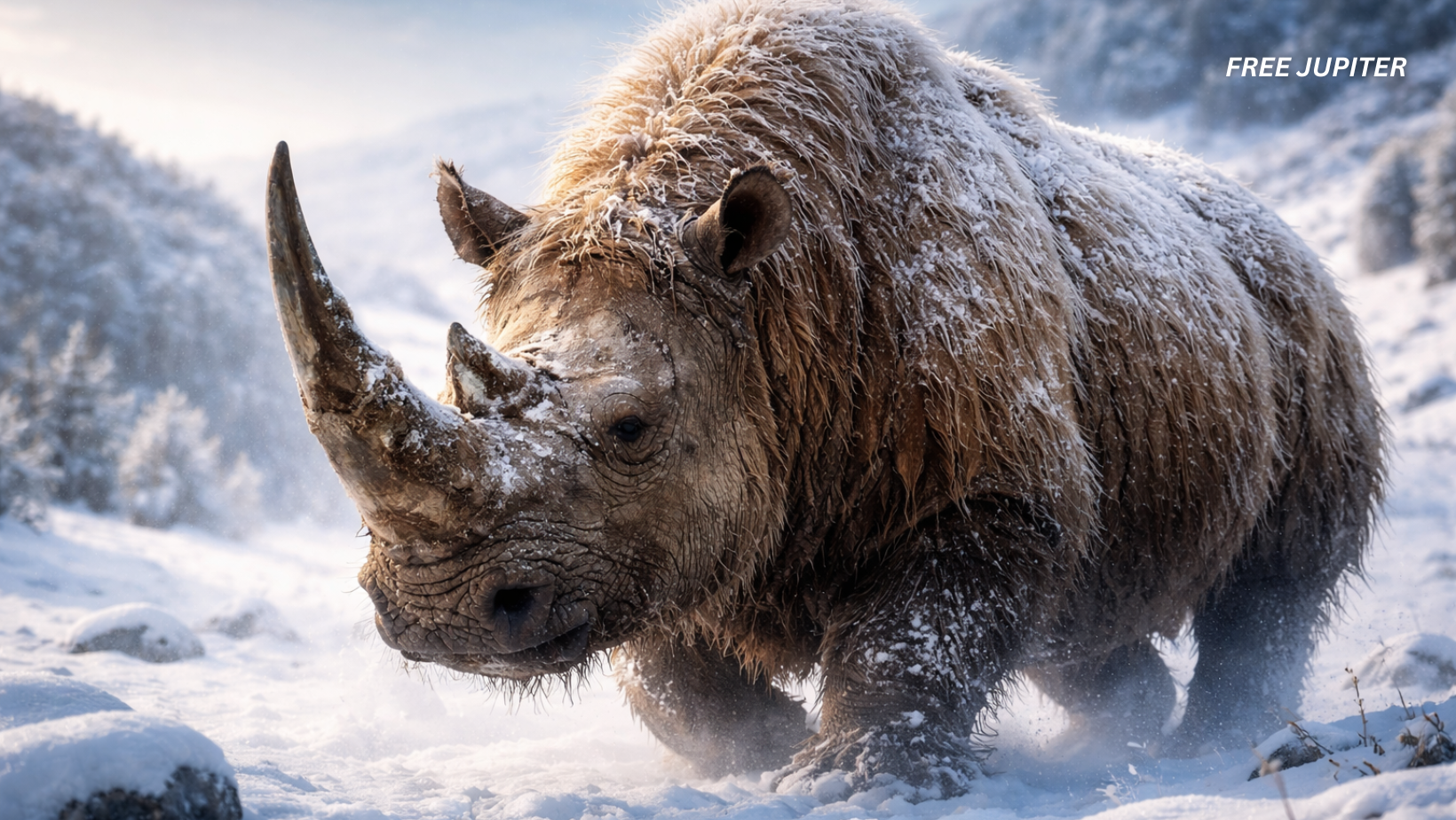
The woolly rhinoceros, scientifically known as Coelodonta antiquitatis, was a massive herbivore adapted to survive in extremely cold environments. Roughly similar in size to today’s white rhinoceros, it was built like a living tank. Thick skin, powerful limbs, and a heavy coat of fur allowed it to withstand brutal winters and icy winds.
These animals thrived on open grasslands known as the mammoth steppe, grazing on hardy vegetation that could survive freezing temperatures. For thousands of years, woolly rhinos successfully coexisted with predators like wolves and early human hunters. Their extinction, therefore, has long puzzled scientists.
Finding rhino tissue inside a wolf pup suggests that even these formidable animals were not immune to predation, especially when young or weakened. While a single pup could not bring down a rhino alone, it is likely that an entire wolf pack was involved, with the pup feeding on the remains afterward.
Unlocking an Entire Ice Age Genome
What sets this discovery apart from earlier finds is what scientists were able to do with the preserved rhino tissue. Using advanced genetic techniques, researchers successfully sequenced the entire genome of the woolly rhinoceros from muscle tissue found inside the wolf pup’s stomach.
This marked the first time a complete genome of an Ice Age animal was recovered from the stomach contents of another animal. DNA usually degrades over time, breaking into fragments and becoming difficult to analyze. Recovering a full genome from material that had been eaten and partially digested was considered nearly impossible.
The permafrost, however, acted as a natural freezer, slowing the breakdown of genetic material. This allowed scientists to extract high quality DNA and assemble a detailed genetic blueprint of the woolly rhino, offering insights never before possible.
Comparing Rhinos Across Tens of Thousands of Years
To understand what the genome revealed, researchers compared this newly sequenced rhino with two other woolly rhinoceros genomes from Siberia. One of these animals lived about 18,000 years ago, while the other lived nearly 49,000 years ago.
By comparing these genomes, scientists could track changes in genetic diversity, population size, and inbreeding over tens of thousands of years. These factors often provide clues about whether a species was struggling or thriving before extinction.
Surprisingly, the results showed remarkable stability. The woolly rhinoceros population did not display signs of increasing inbreeding or genetic decline leading up to its disappearance. In other words, the species was not slowly fading away due to poor genetics or a shrinking population.
Rethinking the Role of Humans in Extinction
For many years, human hunting has been blamed for the extinction of large Ice Age animals. Humans are believed to have arrived in northeastern Siberia around 15,000 years before the woolly rhinoceros vanished. If hunting pressure were the main cause, scientists would expect to see signs of population stress in the animal’s DNA.
Instead, the genetic evidence suggests that woolly rhinos maintained healthy and stable populations even after humans appeared in the region. There was no clear genetic signal of overhunting or long term decline caused by human activity.
This finding shifts attention toward another powerful force, rapid climate change at the end of the Ice Age.
Related article:Scientists Say More Animals Are Conscious Than We Ever Imagined—Even Insects
Climate Change and a Sudden Disappearance
As the Ice Age came to an end, global temperatures began to rise. The cold, dry grasslands that supported woolly rhinos gradually transformed into wetter landscapes filled with shrubs, forests, and melting ice. These changes dramatically altered the ecosystem.
The woolly rhinoceros was highly specialized for life on frozen steppe grasslands. As these habitats disappeared, so did the food sources the animals depended on. According to the genetic data, this environmental shift appears to have triggered a rapid extinction rather than a slow decline.
The genome shows no evidence of long term stress or gradual population collapse. Instead, it suggests that the species disappeared quickly, within just a few centuries. This sudden loss helps explain why woolly rhinos vanished completely, leaving behind no living descendants.
Related article: Wildlife Experts Warn: Never Release These 17 Animals Into the Wild
Why This Discovery Matters Today
Beyond solving an ancient mystery, this research has important implications for the modern world. By studying genomes from animals that lived shortly before extinction, scientists can better understand how species respond to rapid environmental changes.
Many animals today face similar threats, including rising temperatures, habitat loss, and shifting ecosystems. The story of the woolly rhinoceros serves as a reminder that even strong, well adapted species can disappear quickly when their environment changes faster than they can adapt.
The unlikely connection between a wolf pup and a woolly rhinoceros has given scientists an unprecedented look into Ice Age life. A single frozen meal, preserved by chance, has reshaped our understanding of extinction and highlighted how fragile even the mightiest creatures can be in the face of a changing planet.
Featured image: GPT Creation.
Friendly Note: FreeJupiter.com shares general information for curious minds. Please fact-check all claims and double-check health info with a qualified professional. 🌱