

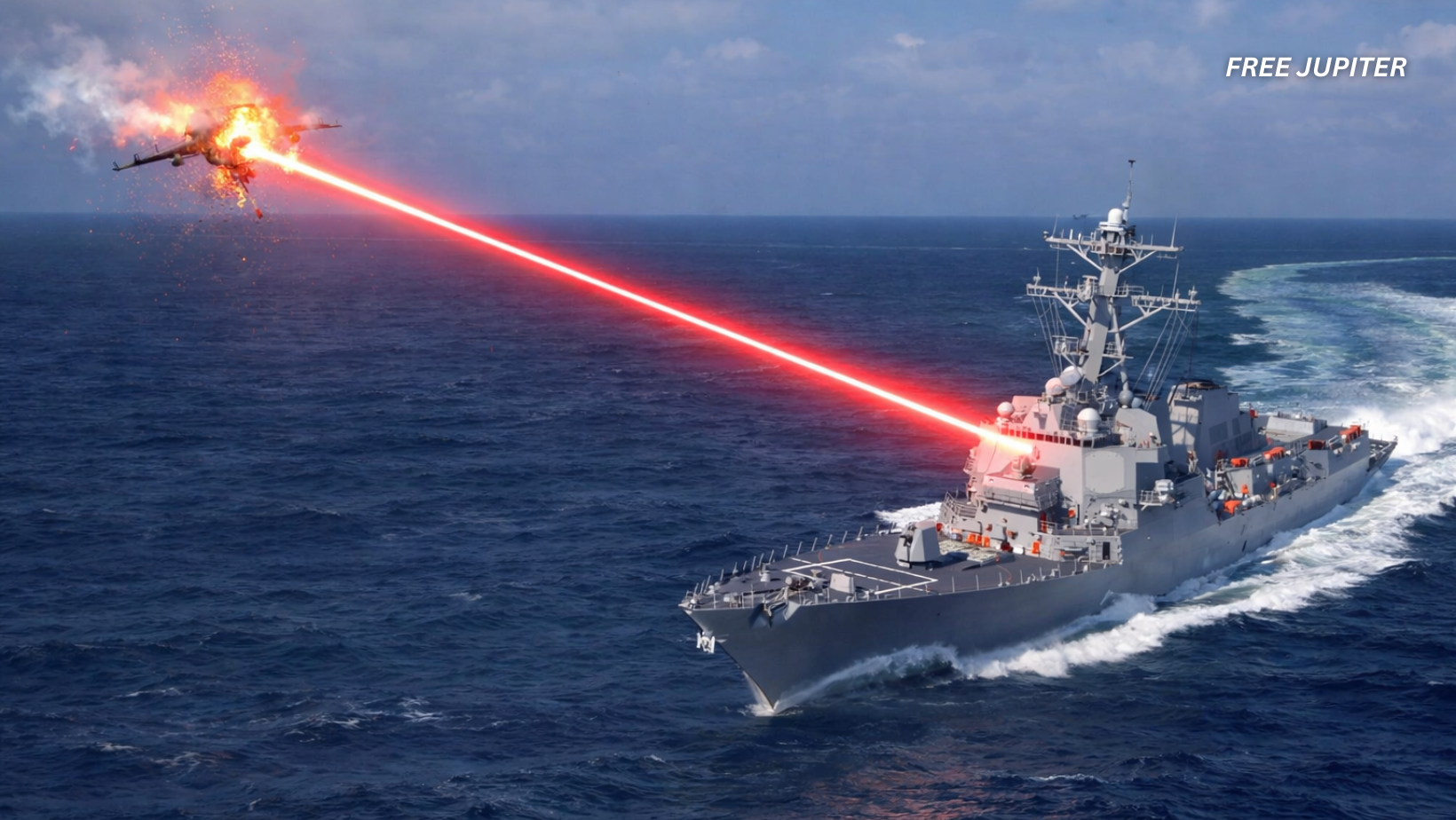
In a remarkable leap forward for naval defense, Japan has begun testing a 100-kilowatt laser weapon on one of its 6,200-ton warships. This new system is not just a futuristic display; it has the practical ability to cut through metal and target drones in mid-air, offering a glimpse into how modern warfare is evolving with technology.
The concept behind the weapon is relatively straightforward yet technologically impressive. Instead of relying on conventional projectiles or missiles, this system generates a highly concentrated beam of light. It achieves its full power by combining ten smaller lasers, each rated at 10 kilowatts, into a single 100-kilowatt beam.
This concentrated energy allows it to burn through metal surfaces and neutralize small aerial threats with remarkable precision.
A Cost-Effective Alternative to Conventional Weapons
One of the most significant advantages of this laser weapon is its cost efficiency. Traditional air-defense systems rely on expensive missiles that are used once and then discarded. By contrast, the laser uses electricity to operate. This means that as long as the ship has power, it can keep firing, earning the description of having “unlimited magazine depth.” In practical terms, each shot costs only a fraction of what a missile might, making it a potentially game-changing tool for defending ships against swarms of drones or small airborne threats.
This approach is already drawing comparisons to other nations that have invested heavily in laser technology. The United States has been testing laser weapons on naval vessels for several years, with the USS Portland and USS Preble showcasing systems capable of shooting down drones and small boats. European nations such as France, Germany, and the United Kingdom are also developing their own directed-energy weapons, underscoring a growing global trend toward high-tech, low-cost defense solutions. Japan’s move places it firmly within this elite group of nations exploring the next generation of military technology.
Related article: Earth Receives Final NASA Laser Transmission From 218 Million Miles Away
How the Laser Works
The laser’s mechanism is elegantly simple in principle but complex in execution. Each of the ten individual lasers generates a beam of light that is then combined into a single, highly focused stream of energy. When directed at a target, this beam rapidly heats the surface, essentially melting or burning through metal. This makes it effective not only against drones but also against light vehicles, mortar rounds, and other airborne threats that may pose a danger to the ship.
Unlike traditional weapons, which rely on the kinetic impact of a missile or shell, the laser’s effectiveness depends on its energy output and the time it is focused on a target. This precision allows for selective targeting, reducing the risk of collateral damage. For example, a drone approaching a ship could be neutralized without harming nearby civilian vessels or infrastructure.
Preparing for the Ocean Test
The Japanese Ministry of Defense has announced that sea trials for the laser system will begin after February 27, 2026. These trials are designed to test the laser in real-world maritime conditions, which can be extremely challenging. Factors such as wind, humidity, saltwater spray, and waves all affect how a laser beam propagates. Testing in these conditions is crucial to ensure the system performs reliably when deployed in actual defense scenarios.
Sea trials will likely include scenarios such as intercepting drones flying at varying speeds and altitudes, as well as simulating attacks from lightweight artillery shells or mortars. The tests will help military engineers understand how the laser reacts under dynamic conditions and refine its targeting algorithms for maximum effectiveness.
Real-World Implications
The deployment of laser weapons on naval ships has implications far beyond technological bragging rights. In the near future, such systems could redefine naval strategy and ship design. Smaller vessels that could not previously afford complex missile systems might be equipped with lasers as a cost-effective defense. Swarms of inexpensive drones, which pose a significant threat to modern naval forces, could be neutralized quickly without draining resources.
Japan’s decision also reflects broader geopolitical considerations. In a region with increasing maritime tensions and advanced drone technology proliferating, having a reliable and affordable means of defense is critical. While missiles remain an important part of a navy’s arsenal, the addition of a laser weapon adds flexibility and lowers operational costs.
Comparisons to Science Fiction and Popular Culture
For many, the concept of a laser slicing through metal or shooting down drones might evoke images from science fiction. Popular movies and video games have long portrayed directed-energy weapons as futuristic tools, yet Japan’s trials show that this technology is no longer fiction. The ability to focus light into a destructive beam is becoming a reality, and the technology is advancing faster than many anticipated.
To give a more tangible example, imagine a small drone flying toward a ship. Currently, the typical response would involve launching a missile or firing a machine gun, both of which are expensive, require ammunition, and may risk collateral damage. With a laser system, the ship could target the drone, heat its casing, and neutralize it within seconds—all while conserving physical resources. This is particularly valuable in scenarios where multiple drones attack simultaneously, a situation becoming more common with advances in drone swarming technology.
Related article: Laser-Free Eye Surgery Could Correct Vision With Electrical Currents
Global Race in Directed-Energy Weapons
Japan is not alone in pursuing this path. The United States has invested billions in directed-energy research, with the Office of Naval Research demonstrating lasers capable of shooting down small aircraft and surface vessels. France has developed a similar system for coastal defense, and Germany is testing high-energy laser systems for use on its frigates. The United Kingdom has also announced plans to deploy laser weapons on future ships.
By joining this elite group, Japan is signaling its commitment to maintaining technological parity with other major naval powers. Directed-energy weapons are seen as the future of defense, providing speed, precision, and cost efficiency that conventional systems cannot match.
Challenges and Considerations
While the technology is promising, challenges remain. Laser effectiveness can be influenced by weather, particularly rain, fog, or heavy sea spray. Energy storage and cooling systems must be robust to maintain continuous operation. Additionally, the integration of lasers into existing naval systems requires careful planning to ensure crew safety and operational efficiency.
Despite these hurdles, Japan’s progress highlights how rapidly military technology is evolving. What once seemed like science fiction is now under active development, tested at sea, and ready to become part of modern naval defense strategies.
Related article: Nature’s First Laser Gun? Researchers Discover Peacock Feathers Emit Laser-Like Beams
Conclusion
Japan’s 100-kilowatt laser weapon marks a significant step forward in naval defense technology. By combining cost efficiency with high precision, this system could reshape how ships defend themselves against drones and other airborne threats. With sea trials on the horizon, the world will soon get a clearer picture of how effective directed-energy weapons can be in real-world conditions.
This development also underscores a global shift toward innovative, high-tech solutions in defense. As Japan joins the United States, France, Germany, and the United Kingdom in exploring laser-based weaponry, the era of conventional missiles and artillery may slowly give way to energy-based systems that are faster, cheaper, and incredibly precise.
From science fiction to reality, Japan’s laser trials demonstrate that the future of naval defense is not just about bigger ships or more missiles, but about smarter, faster, and more efficient ways to protect fleets in an increasingly complex maritime world.
Featured image: GPT recreation for illustrative purposes.
Friendly Note: FreeJupiter.com shares general information for curious minds. Please fact-check all claims and double-check health info with a qualified professional. 🌱