

More than half a century ago, thousands of barrels filled with industrial waste were dumped into the Pacific Ocean off the coast of Southern California. At the time, deep ocean waters were treated as an endless storage space. Today, those decisions are resurfacing in an unexpected way.
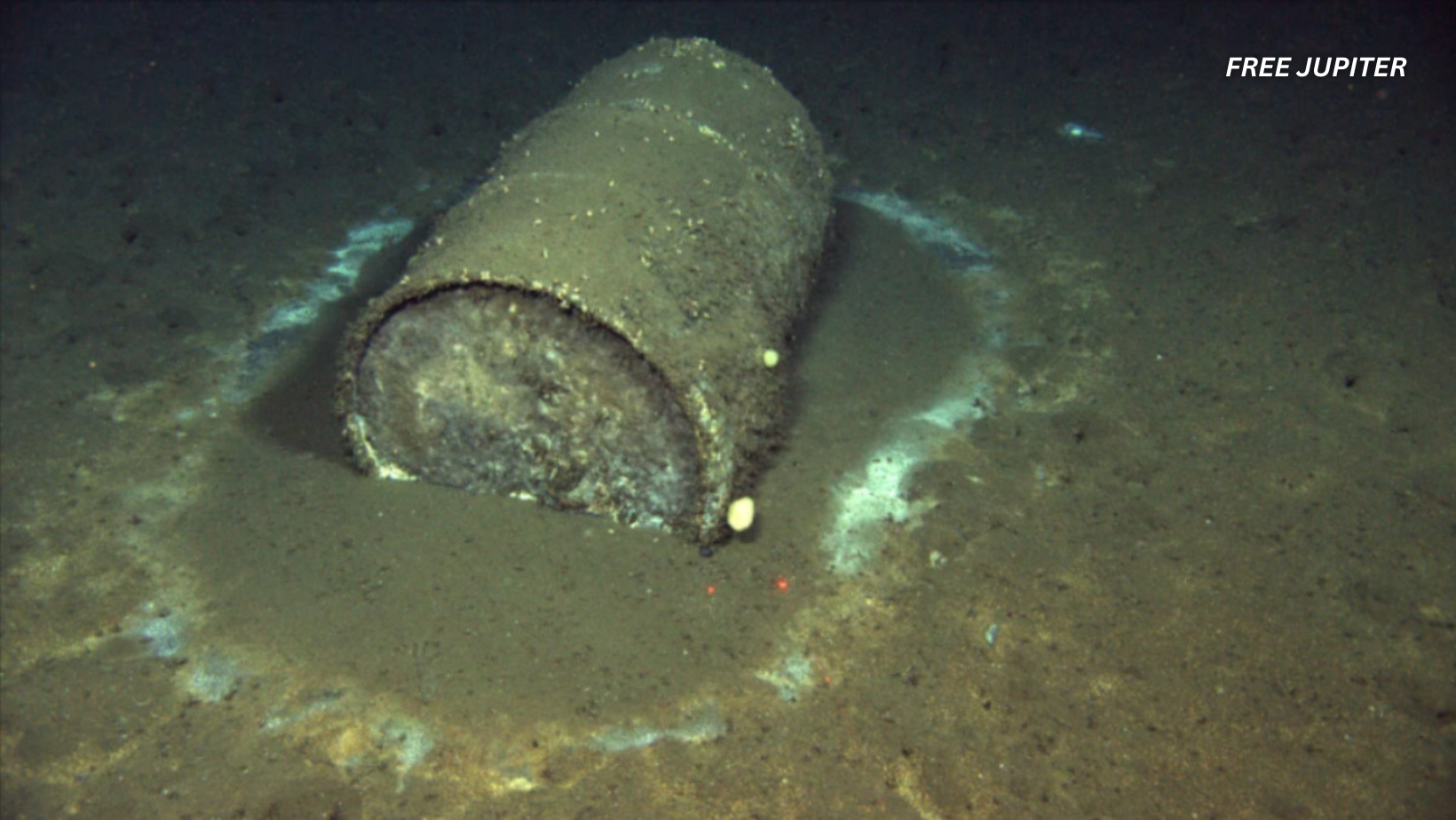
Researchers have discovered pale white rings forming in the mud around many of those aging barrels. These faded halos are not just stains. They are chemical scars, and they suggest that highly corrosive waste has been leaking into the seafloor for decades.
The findings reveal something unsettling. What was discarded long ago has not disappeared. Instead, it has been slowly reshaping deep ocean habitats in ways scientists are only now beginning to understand.
White Rings in the Darkness
Far below the waves in the San Pedro Basin near Los Angeles, the ocean floor is usually dark and soft with sediment. Yet in certain areas, researchers found bright, chalky rings surrounding rusted barrels.
When scientists collected mud samples from these pale rings, they noticed hardened crusts and powdery patches embedded within otherwise dark sediment. These white areas stood out sharply against the surrounding seabed.
A research team from the Scripps Institution of Oceanography analyzed the material and traced it to leaking alkaline waste. Alkaline substances are highly basic on the pH scale, which measures acidity and alkalinity. Normal seawater sits around a pH of 8. The sediment near the barrels reached levels close to 12, which is extremely alkaline.
That shift in chemistry is not minor. It represents a dramatic change in the local environment.
Related article:Scientists Discover “Octlantis,” an Underwater ‘City’ of Octopuses in Australia Who Built Homes And Live Together
Mapping an Underwater Dumping Ground
To understand the scale of the problem, researchers conducted a detailed survey of the seafloor. Using robotic submarines equipped with sonar and cameras, they scanned approximately 58 square miles of the San Pedro Basin.
The result was a dense map of debris scattered across the ocean floor. Analysts identified more than 74,000 debris targets. Around 27,000 of those appeared to be barrel shaped objects.
The sheer number makes investigation difficult. Each dive can only examine a small number of sites. Scientists must choose carefully which barrels to sample, almost like triage in a vast underwater scrapyard.
The white halos have become useful clues. Because they remain visible in the sediment, they help researchers quickly identify likely leakage sites before any chemical tests are even performed.
Not All Roads Lead to DDT
For years, many people assumed the rusting barrels were leaking DDT, a pesticide once widely used in the United States. DDT was banned in 1972 but is known for lingering in the environment and building up in marine food webs.
When researchers tested sediment near the barrels, they did detect DDT in the region. However, the levels remained high across the broader dump site regardless of proximity to specific barrels. In other words, the presence of white halos did not correspond with spikes in DDT.
That pattern suggested that the barrels surrounded by halos were not acting as fresh sources of DDT. The chemical rings appeared to be caused by something else.
The culprit turned out to be strongly alkaline waste.
How Chemistry Paints a Ring
When alkaline chemicals leaked from certain barrels, they reacted with the surrounding seawater and sediment. This interaction triggered a series of chemical changes.
Seawater contains magnesium. In highly alkaline conditions, magnesium reacts to form a mineral called brucite, which is magnesium hydroxide. Brucite can harden sediment grains and create crusty rims that resist slow currents and natural disturbance.
Over time, these reactions formed pale rings around leaking barrels. Even if the initial spill slowed or stopped, the mineral crust continued to buffer the sediment toward high alkalinity. Brucite dissolves very slowly in seawater, releasing basic compounds that maintain elevated pH levels.
As a result, the rings have persisted for decades and may remain for thousands of years.
Related article: How Dolphins Developed the Ability to ‘See’ Underwater with Sound, Explained by Science
Microbial Life Under Pressure
The deep ocean floor may look barren, but it supports communities of microorganisms that play vital roles in recycling nutrients like nitrogen and sulfur.
When scientists examined sediment from the white halos, they found far fewer microbes than in nearby unaffected mud. The genetic material typically present in healthy seafloor communities was largely absent.
In the extreme alkaline conditions near the barrels, only specialized bacteria that thrive in high pH environments were able to survive. These alkaliphilic microbes replaced the diverse communities that once lived there.
Reduced microbial diversity can ripple through the ecosystem. Microbes help break down organic matter and recycle nutrients. When their numbers decline or their composition shifts dramatically, larger seafloor organisms may also be affected.
The chemical rings are not just cosmetic marks. They represent altered ecosystems at the microscopic level.
A Legacy That Lingers
Researchers estimate that the chemical effects in some parts of the basin could last several thousand years. The mineral crusts slow down chemical change, locking in high pH conditions for extended periods.
This persistence complicates future action. Even careful sampling can disturb sediment and potentially spread alkaline material to new areas. Decisions about investigation and possible cleanup must weigh the risks of leaving barrels undisturbed against the risks of intervention.
At depths of around 3,000 feet, any operation relies on robotic systems and long cables. A single mistake could disperse corrosive substances into surrounding waters.
How Ocean Dumping Became Policy
From the 1930s through the early 1970s, deep ocean dumping was considered an acceptable waste management strategy. Industrial byproducts, oil drilling debris, low level radioactive waste, and even obsolete military explosives were sent offshore.
The United States Environmental Protection Agency has records describing at least 14 deep water dumping locations off Southern California.
Thin steel barrels were used to contain many of these materials. They were never designed to last for decades under corrosive seawater conditions. Today, many are severely rusted, and their original contents are not fully documented.
The lack of detailed records leaves scientists with unanswered questions.
What Remains Unknown
Even with improved maps, researchers cannot yet determine which barrels remain sealed and which have already emptied into the sediment. Roughly one third of the barrels show white halos, indicating alkaline leakage in their immediate surroundings.
There are additional concerns. Alkaline leaks can mobilize metals trapped in sediment. If those metals enter marine organisms such as fish or shellfish, they could move up the food chain. At present, it remains unclear whether this is happening.
The scale of the dump site and the incomplete inventory of materials make it difficult to draw firm conclusions.
The Dilemma of Cleanup
Any cleanup plan faces difficult tradeoffs. Removing barrels could disturb fragile sediment layers and release trapped chemicals. Leaving them in place may allow continued slow leakage.
The EPA has conducted new surveys and sampling efforts, but a comprehensive inventory of barrel contents has yet to be completed. Policymakers must decide whether modern environmental standards require a response to decades old dumping practices.
In the meantime, scientists are using visible halos as a practical way to prioritize research sites. Each pale ring tells a story about chemical change beneath the sea.
Related article: The ‘Ocean Spiral’: Japan’s Groundbreaking New Underwater City Will Run on Deep-Sea Thermal Energy
A Long Shadow Beneath the Waves
The rusting barrels scattered across the San Pedro Basin are reminders that environmental decisions can echo across generations. What was once considered out of sight has proven not to be out of impact.
The white rings etched into the ocean floor show that industrial waste continues to shape deep sea chemistry long after dumping ceased. Through improved mapping, careful sampling, and patient study, researchers are gradually uncovering the extent of the transformation.
The story is not just about barrels or minerals. It is about how human choices can linger in unexpected places, even thousands of feet below the surface.
Featured image: Toxic DDT Barrels
Friendly Note: FreeJupiter.com shares general information for curious minds. Please fact-check all claims and double-check health info with a qualified professional. 🌱