

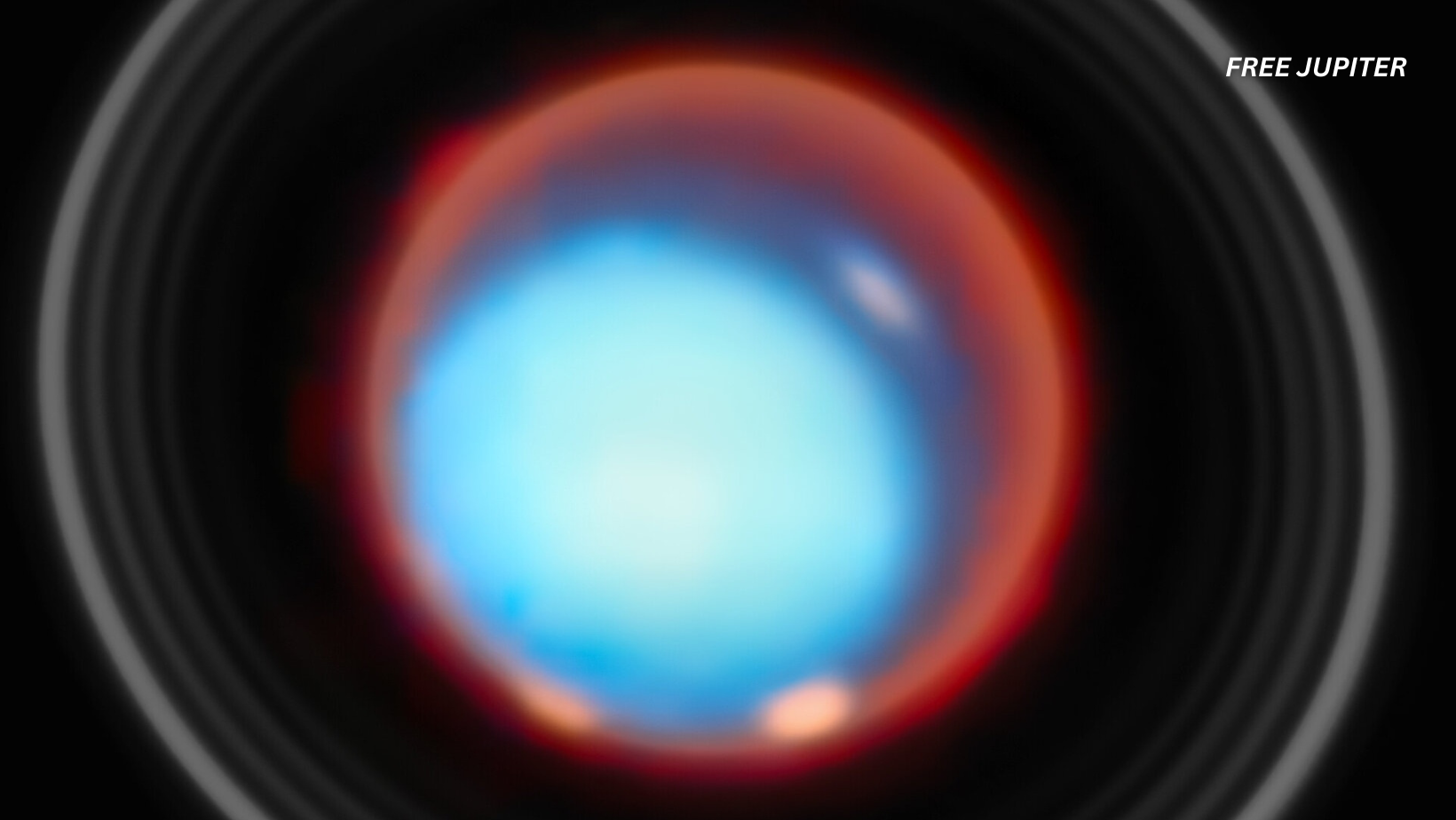
For decades, Uranus has remained one of the most mysterious planets in our solar system. Pale blue, distant, and oddly tilted, it has often been described as the quiet outlier among the giant planets. Now, thanks to the James Webb Space Telescope, scientists have been able to look deeper into its atmosphere than ever before. What they found is beginning to reshape how we understand not only Uranus, but also a whole category of planets known as ice giants.
The European Space Agency recently shared results from a study that used the powerful space telescope, built jointly by NASA and ESA, to examine Uranus in remarkable detail. This marks the first time the telescope has studied the planet’s upper atmosphere with such precision. It may sound like just another observation, but in planetary science, a new look often means a new understanding.
Why Uranus Matters More Than You Think
Uranus belongs to a group of planets called ice giants. In our solar system, there are only two of them: Uranus and Neptune. These planets are different from gas giants like Jupiter and Saturn. While gas giants are mostly made of hydrogen and helium, ice giants contain heavier elements such as water, methane, and ammonia. These materials exist under extreme pressure and temperature, forming layers that behave in unusual ways.
Understanding Uranus is important because planets like it appear to be common in other star systems. Many of the exoplanets discovered beyond our solar system are similar in size to Uranus or Neptune. By studying Uranus up close, scientists gain clues about countless distant worlds that orbit other stars.
Related article:It Turns Out That Uranus And Neptune Might Not Actually Be Ice Giants After All, Study Says
Peering Into the Ionosphere
The new research focused on a region high above Uranus’ visible clouds called the ionosphere. This layer stretches thousands of kilometers into space. It is filled with electrically charged particles known as ions. Because these particles carry electric charge, they respond strongly to magnetic fields.
In simple terms, the ionosphere acts like a glowing sign that reveals how a planet’s magnetic field behaves. By measuring activity in this region, scientists can learn about the invisible forces generated deep inside the planet’s interior.
Uranus has one of the strangest magnetic fields in the solar system. Unlike Earth’s magnetic field, which is mostly aligned with its rotation, Uranus’ magnetic field is tilted at a dramatic angle and offset from the planet’s center. This unusual structure causes its auroras to move in complex patterns across the atmosphere.
Auroras on Uranus are similar in concept to the northern and southern lights on Earth. They occur when charged particles interact with the magnetic field and energize atmospheric gases, producing glowing displays. However, Uranus’ auroras are especially intriguing because of the planet’s tilted axis and lopsided magnetosphere.
How the James Webb Telescope Made the Discovery
The James Webb Space Telescope is designed to observe the universe in infrared light. Infrared wavelengths allow scientists to detect heat and study objects that may not be visible in ordinary light.
For this study, researchers used one of Webb’s key instruments called the Near Infrared Spectrograph, often shortened to NIRSpec. Instead of capturing just a single image, the team observed Uranus through a full rotation of the planet. This allowed them to gather information from every side rather than just one hemisphere.
By combining the data, scientists created a three dimensional map of Uranus’ upper atmosphere. This is far more informative than a flat picture. It reveals how temperature and ion density vary across different regions and altitudes.
The results were striking. The highest temperatures were detected between 3,000 and 4,000 kilometers above the cloud tops. Meanwhile, the greatest concentration of ions appeared much lower, around 1,000 kilometers above the clouds. These differences provide important clues about how energy moves through the planet’s atmosphere.
If those distances sound enormous, keep in mind that Uranus itself is massive. Its diameter is about four times that of Earth. The scale of everything happening in its atmosphere is equally vast.
Rethinking a “Cold” Planet
For years, Uranus was often described as the coldest planet in the solar system. Voyager 2, which flew past Uranus in 1986, gathered data that suggested it emitted very little internal heat compared to other giant planets.
However, more recent studies have hinted that the story might be more complicated. Some research has suggested that parts of Uranus may be warmer than previously believed. The new temperature measurements from the James Webb Space Telescope add another piece to this puzzle.
Finding warmer regions high in the atmosphere raises new questions about what is happening inside the planet. Is heat being transported differently than scientists expected? Is there more internal activity than earlier measurements indicated? These are questions that researchers will continue exploring as they analyze the growing dataset.
Related article: Uranus Is Leaking Much More Heat Than We Thought
The Legacy of Voyager 2
Much of what we know about Uranus originally came from Voyager 2. The spacecraft’s flyby more than forty years ago provided humanity’s first close look at the planet. It revealed a smooth looking atmosphere, faint rings, and an unusual magnetic field.
At the time, that single encounter transformed our understanding of Uranus. Yet it was still only a brief visit. Voyager 2 did not stay in orbit. It passed by and continued its journey outward.
Now, with advanced telescopes like Webb, scientists can revisit Uranus with tools that were unimaginable in the 1980s. Instead of relying on a quick snapshot, they can observe the planet repeatedly, across different wavelengths, and with extraordinary sensitivity.
Why This Discovery Extends Beyond Uranus
This research does more than describe one planet’s atmosphere. It helps refine models of how ice giants work in general. By mapping temperature and charged particles in Uranus’ ionosphere, scientists can test theories about magnetic field generation and atmospheric heating.
These insights can then be applied to Neptune and to distant exoplanets that resemble Uranus in size and composition. In other words, a closer look at one planet helps decode patterns across the galaxy.
The James Webb Space Telescope was built to study the earliest galaxies and distant stars, but it is proving just as powerful when pointed at our own cosmic neighborhood. Its ability to capture infrared light with such clarity opens new windows into planetary science.
Related article:63 Earths Can Fit Inside Of Uranus
Looking Ahead
There is growing interest in sending another spacecraft to Uranus in the future. A dedicated mission could orbit the planet for years, providing continuous measurements that telescopes alone cannot achieve. Until then, instruments like the James Webb Space Telescope serve as our best remote laboratories.
By turning its infrared vision toward this distant ice giant, Webb has revealed that Uranus is far from simple. It is dynamic, layered, and complex. Its upper atmosphere is warmer and more structured than once assumed. Its magnetosphere remains one of the strangest in the solar system.
Featured image credit: ESA/Webb, NASA, CSA, STScI, P. Tiranti, H. Melin, M. Zamani (ESA/Webb)
Friendly Note: FreeJupiter.com shares general information for curious minds. Please fact-check all claims and double-check health info with a qualified professional. 🌱