
Human beings have always had a habit of placing themselves at the center of everything. It is an easy perspective to adopt. We build cities, create technology, and reflect on our own existence. From that point of view, it can feel natural to assume that we sit at the top of the ladder when it comes to intelligence and awareness.
Yet when the lens is widened, that assumption begins to feel less certain. Compared to the vast sweep of Earth’s history, humans are newcomers. If the entire timeline of our planet were compressed into a single hour, humanity would appear only in the final seconds. Meanwhile, other forms of life have been present for billions of years, adapting, surviving, and shaping the environment long before we arrived.
Rethinking What Consciousness Means
Before diving into the idea itself, it helps to pause and consider a basic issue. No one fully agrees on what consciousness actually is.
Some people define it as self awareness, the ability to think about one’s own thoughts. Others see it as the capacity to feel, respond, or make choices. There are also those who describe it as a continuous stream of experience, shaped by perception and memory.
The challenge is that these definitions often reflect human experience. They assume that awareness must look and feel the way it does in us. But what if consciousness comes in many forms, some of which are far simpler and less reflective than our own?
Related article: Your Consciousness Might Be Powered by a Hidden Quantum Field, New Theory Claims
The Idea That Life and Awareness Are Linked
In the late twentieth century, a concept known as the Cellular Basis of Consciousness began to gain attention. This idea proposes something both simple and radical. It suggests that life itself and consciousness may be deeply connected.
According to this perspective, every living organism, no matter how small, has some form of awareness. Even single celled organisms, such as bacteria, may not be as passive as they seem. Instead, they appear capable of sensing their environment, making decisions, and even learning from experience.
Scientists have observed behaviors in these tiny organisms that seem surprisingly complex. Some bacteria can detect changes around them and adjust their actions accordingly. Others can move toward helpful conditions and avoid harmful ones. These responses are not random. They show a level of coordination that hints at something more than simple chemical reactions.
The Curious Case of the “Thinking” Slime Mold
One of the most fascinating examples comes from a type of organism often referred to as slime mold. Despite its simple structure, this organism has demonstrated abilities that seem almost problem solving in nature.
In laboratory settings, slime molds have been placed in maze like environments. Over time, they have managed to find efficient paths through these mazes, even without any obvious guidance such as food cues. The routes they choose often resemble solutions that humans might consider logical or optimal.
What makes this especially intriguing is that the organism has no brain, no nervous system, and no centralized control. Its entire body is made up of a network of cells working together. Yet somehow, it behaves as if it is making decisions.
Communication Among the Smallest Life Forms
Bacteria, often thought of as the simplest forms of life, also display unexpected abilities. In certain environments, they communicate with one another using chemical signals. This process allows them to sense how many of them are present in a given area.
When their population reaches a certain level, they can act together in coordinated ways. For example, some marine bacteria only produce light when there are enough of them gathered in one place. Individually, they remain dark. Collectively, they glow.
This kind of group behavior suggests a form of shared awareness. It is not conscious thought as we understand it, but it does involve sensing, processing information, and responding as a unit.
Do Plants Have a Form of Awareness?
The conversation becomes even more intriguing when plants are considered.
At first glance, plants appear passive. They do not move in ways that are easily noticeable, and they lack brains or nervous systems. However, research has revealed that plants are far more responsive than they seem.
Certain plants react to touch, light, temperature, and even sound. Some can adjust their growth patterns based on environmental conditions. Others can detect chemical signals from nearby plants and respond accordingly.
There have also been experiments showing that plants can learn from repeated experiences. For instance, a plant that is exposed to a harmless disturbance multiple times may eventually stop reacting to it. Even after a period of rest, it can “remember” that the disturbance is not a threat.
Related article: 7 Signs That You’re Subconsciously Using the ‘Grey Rock Method’ on Difficult People, According to Psychologists
The Role of Energy and Information
Another line of thought looks at the role of energy and information in shaping awareness. Some scientists suggest that consciousness may arise from the way biological systems interact with their environment at a fundamental level.
In this view, cells are not just passive building blocks. They are dynamic systems that process energy and exchange information continuously. These interactions may give rise to forms of awareness that are subtle but real.
There are also more speculative ideas involving quantum processes within cells. Certain structures inside cells, known as microtubules, have been proposed as potential sites where these processes occur. While this area of research remains debated, it highlights how much is still unknown about the nature of consciousness.
Could Entire Ecosystems Be Aware?
If awareness exists at the level of individual cells, it raises an even bigger question. What happens when countless cells come together in large, interconnected systems?
Forests, for example, are made up of vast networks of plants, fungi, and microorganisms. These systems exchange nutrients and information through underground connections. Some scientists have suggested that such networks could function in ways that resemble a kind of collective awareness.
There have been observations of trees responding to threats by releasing chemical signals that warn nearby plants. In certain cases, these signals can trigger defensive responses across an entire area.
One well known example involves trees increasing the levels of certain compounds in their leaves when they are being heavily grazed. Nearby trees, upon detecting the signal, may do the same, making their leaves less appealing to herbivores.
A Humbling Perspective on Life
All of these findings invite a shift in perspective. If awareness is not limited to humans, then life on Earth may be far more interconnected than we tend to believe.
Even the smallest organisms play essential roles. Tiny marine life forms help produce a large portion of the oxygen we breathe and absorb significant amounts of carbon dioxide. Plants regulate ecosystems, stabilize climates, and support countless other species.
Meanwhile, human activity has placed increasing pressure on these systems. Environmental changes driven by our actions have led many scientists to warn about large scale ecological disruptions.
Where the Science Stands Today
It is important to note that the idea of universal cellular consciousness remains a topic of debate. Not all scientists agree with it, and many questions remain unanswered.
What is clear, however, is that the boundary between simple life and complex awareness is not as sharp as once believed. Research continues to reveal surprising abilities in organisms that were previously thought to be entirely passive.
As our understanding grows, so does the possibility that consciousness is not a single, fixed phenomenon. Instead, it may exist along a spectrum, ranging from basic responsiveness in single cells to the rich, reflective experience found in humans.
Related article: Consciousness Is Not Confined to the Brain, But Is Connected To The Whole Universe, Scientists Say
A Final Thought
If every living cell carries even a hint of awareness, then the world is far more alive than it appears at first glance. The forests, oceans, and microscopic communities around us may not think or feel in the ways we do, but they are far from inactive.
This idea does not diminish human intelligence. Instead, it places it within a broader context. It reminds us that we are part of a much larger system, one that has been evolving and adapting long before we arrived.
And perhaps that realization is not unsettling, but grounding. It suggests that awareness, in all its forms, is woven into the fabric of life itself.
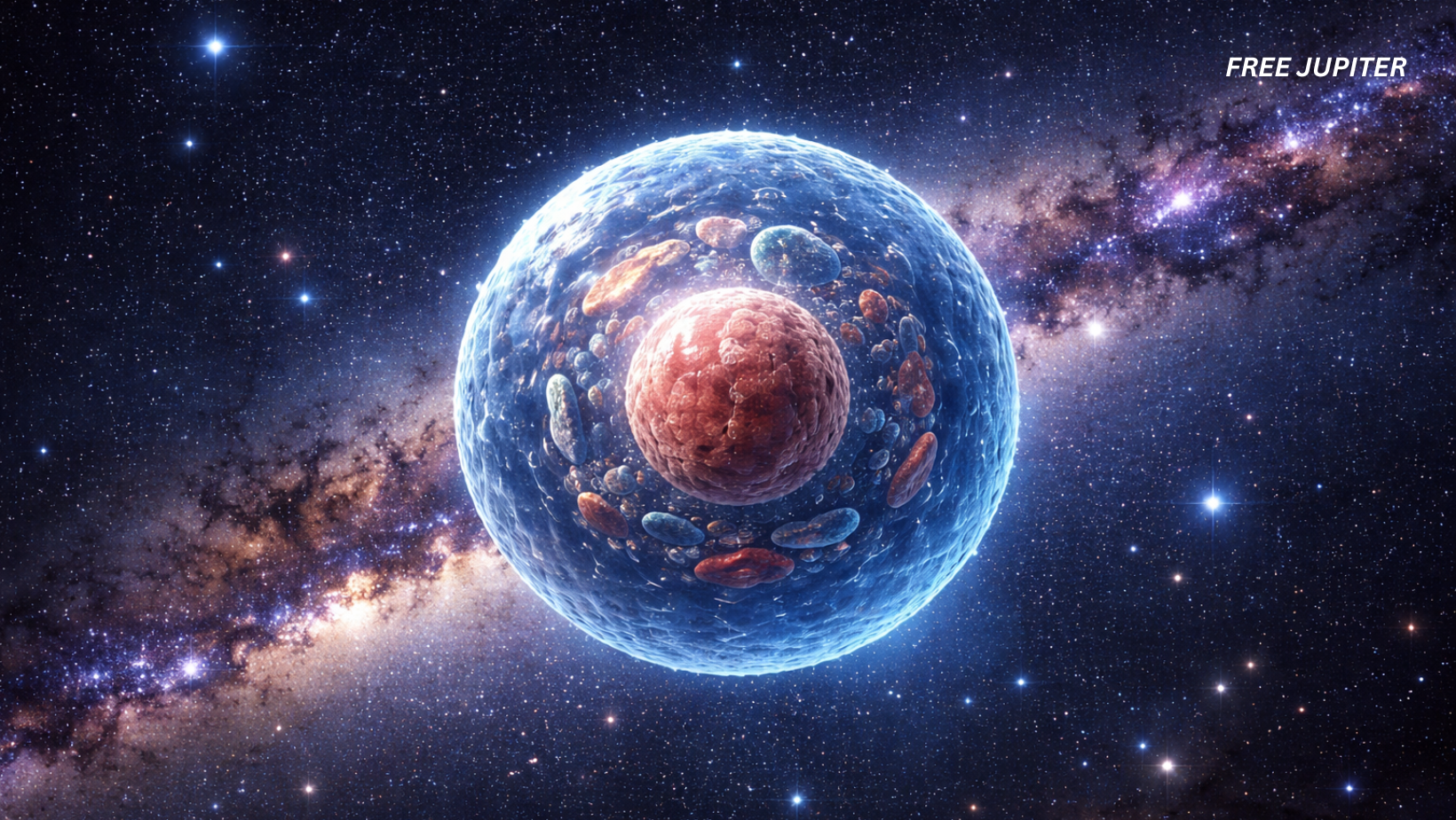
Featured image: GPT Creation.
Friendly Note: FreeJupiter.com shares general information for curious minds. Please fact-check all claims and double-check health info with a qualified professional. 🌱