
The Sun has always been familiar, rising and setting each day without much thought. Yet beneath its bright and steady appearance lies a restless and powerful engine driven by magnetic forces that scientists are only beginning to fully understand. For decades, researchers have known that the Sun’s magnetic field controls everything from sunspots to massive solar storms, but actually seeing those forces in action remained out of reach. That barrier has now been broken.
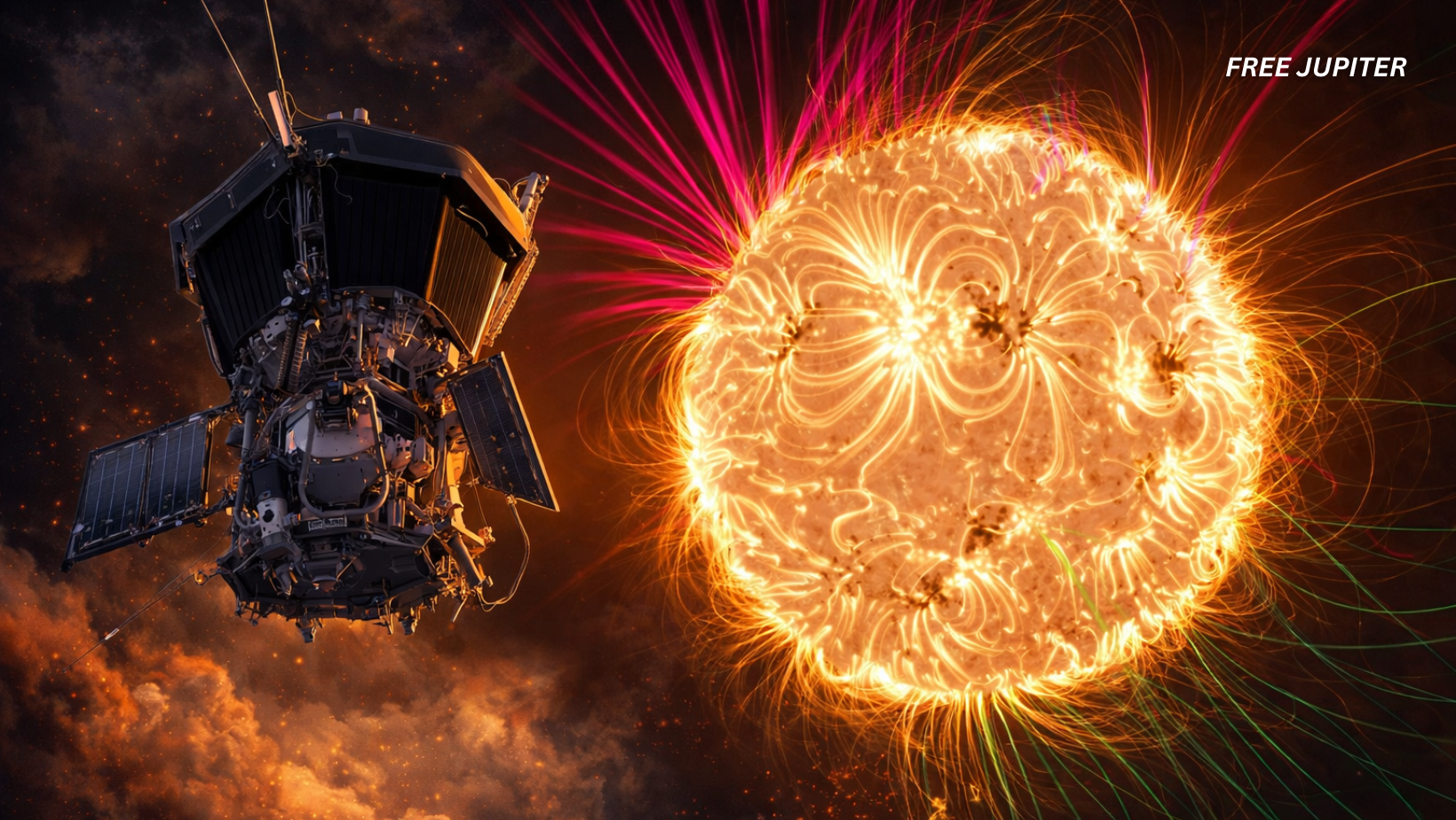
NASA’s Parker Solar Probe has captured the first visual evidence of the Sun’s magnetic activity in motion. During a close encounter with the Sun’s outer atmosphere, the spacecraft recorded footage that allows scientists to watch magnetic structures shifting and twisting in real time. What was once invisible and theoretical has now become observable, marking a historic moment in solar science.
NASA described the footage as the first time the magnetic Sun has been seen moving. This achievement confirms long held theories and opens a new chapter in understanding how our star influences space throughout the solar system.
Related article: Earth’s Seasons Are Now Oddly Out of Sync, New Space Data Has Revealed
A Mission Designed to Go Where No Spacecraft Has Gone Before
The Parker Solar Probe was launched in 2018 with an unprecedented goal. It would travel closer to the Sun than any spacecraft in history, entering regions where temperatures soar and radiation is intense enough to destroy unprotected instruments. To survive, Parker was equipped with a revolutionary heat shield and specially designed sensors that could operate while facing extreme conditions.
Unlike Earth orbiting satellites that observe the Sun from afar, Parker dives directly into the solar environment. Its mission is to study the corona, the Sun’s outer atmosphere, where temperatures rise dramatically and the solar wind is born. Scientists have long puzzled over why the corona is far hotter than the Sun’s surface, and Parker was built to help answer that question.
As the probe made repeated close passes, it encountered turbulent streams of charged particles shaped by powerful magnetic forces. Embedded within those streams were strange patterns that hinted at something dramatic happening beneath the surface.
Here’s the video:
The Discovery of Magnetic Switchbacks
In 2019, Parker’s instruments detected sudden changes in the direction of the magnetic field within the solar wind. These sharp reversals were named magnetic switchbacks. At the time, scientists could measure them but could not see them. Their origin and behavior remained a mystery.
Magnetic switchbacks can be imagined as sudden kinks in invisible magnetic lines, similar to a garden hose snapping back when twisted. These kinks cause bursts of energy that push particles outward, influencing how the solar wind travels through space.
Until recently, switchbacks existed only as spikes in data graphs. The lack of visual confirmation left many questions unanswered. Were they widespread or rare. Were they created near the Sun or farther out in space. The new footage from Parker has finally provided a clearer picture.
Turning Invisible Forces Into Visible Motion
The breakthrough came from Parker’s Wide Field Imager, known as WISPR. This instrument does not photograph magnetic fields directly, since magnetic fields cannot be seen with light. Instead, it tracks the movement of dust and charged particles illuminated by sunlight.
As these particles move, they trace the shape of the magnetic environment around them. By carefully analyzing how the particles shift and swirl, scientists can infer the structure and motion of the magnetic field itself.
The resulting footage reveals distinct patterns linked to magnetic switchbacks. These visual cues allow researchers to watch magnetic energy being released and redirected as the solar wind accelerates away from the Sun. For the first time, scientists can connect measurements with motion, turning abstract data into something tangible.
Why the Sun’s Magnetic Field Matters
The Sun’s magnetic field is the engine behind nearly all solar activity. It generates sunspots, drives solar flares, and powers coronal mass ejections that fling billions of tons of charged material into space. When these eruptions are aimed at Earth, they can interfere with satellites, disrupt radio signals, and in extreme cases damage electrical infrastructure.
Understanding how magnetic energy builds up and releases itself is essential for predicting space weather. Until now, forecasting solar storms has relied heavily on indirect observations and models. The ability to see magnetic behavior directly brings scientists closer to improving those predictions.
Dean Pesnell, a scientist at NASA’s Goddard Space Flight Center, explained that the exact origin of the Sun’s magnetic field is still unknown. It may be generated close to the surface, deep within the Sun, or across multiple layers. The new observations help narrow down these possibilities by showing how magnetic structures behave near the source.
Related article: Scientists Have Finally Revealed Why Women Live Longer Than Men Almost Everywhere on Earth
The Sun’s Ever Changing Magnetic Cycle
The Sun is not magnetically constant. It follows a cycle lasting about eleven years, during which its magnetic field grows stronger, more complex, and then calms again. During solar minimum, the magnetic field is relatively smooth and concentrated near the poles. Sunspots are rare, and solar activity is lower.
As the Sun approaches solar maximum, the magnetic field becomes tangled and chaotic. Active regions spread across the surface, producing sunspots, flares, and eruptions. This is when magnetic switchbacks and other disturbances become more common.
The Parker Solar Probe footage fits neatly into this broader picture. It shows how magnetic energy is released in bursts, reshaping the flow of particles leaving the Sun. These observations help explain how the Sun transitions from calm to active phases and back again.
What This Means for Life and Technology on Earth
While the Sun feels distant, its magnetic behavior directly affects modern life. Communication satellites, navigation systems, aviation routes, and power grids are all vulnerable to intense solar activity. Strong solar storms can cause satellite malfunctions and create electrical surges on the ground.
By studying magnetic switchbacks close to their source, scientists hope to understand how solar storms form and evolve. This knowledge could lead to earlier warnings and better preparation for space weather events.
The Parker Solar Probe does not provide immediate forecasts, but it supplies the foundational data needed to improve long term models. Over time, this could make space weather predictions more accurate and reliable.
Related article: Discovery Under Bermuda Reveals A ‘Structure’ Unlike Any Known On Earth
A New Era of Solar Exploration
The Parker Solar Probe continues to orbit the Sun, making closer passes with each cycle. Each encounter brings new data and sharper insights into the Sun’s behavior. Future observations may reveal how switchbacks form, how common they are, and how they connect to larger solar eruptions.
Even so, this first visual evidence already stands as a milestone. A phenomenon that once existed only in equations and theory has now been observed in motion. The Sun, long studied from a safe distance, has offered a glimpse into its magnetic core.
For scientists and space enthusiasts alike, this moment represents more than just a technical achievement. It marks a shift in how humanity studies its nearest star. The Sun is no longer just measured and modeled. It is being watched as it lives and breathes through magnetic motion.
With each new image, the Parker Solar Probe brings us closer to understanding the forces that shape not only the Sun, but the space environment surrounding Earth itself.
Featured image: GPT Recreation.
Friendly Note: FreeJupiter.com shares general information for curious minds. Please fact-check all claims and double-check health info with a qualified professional. 🌱