

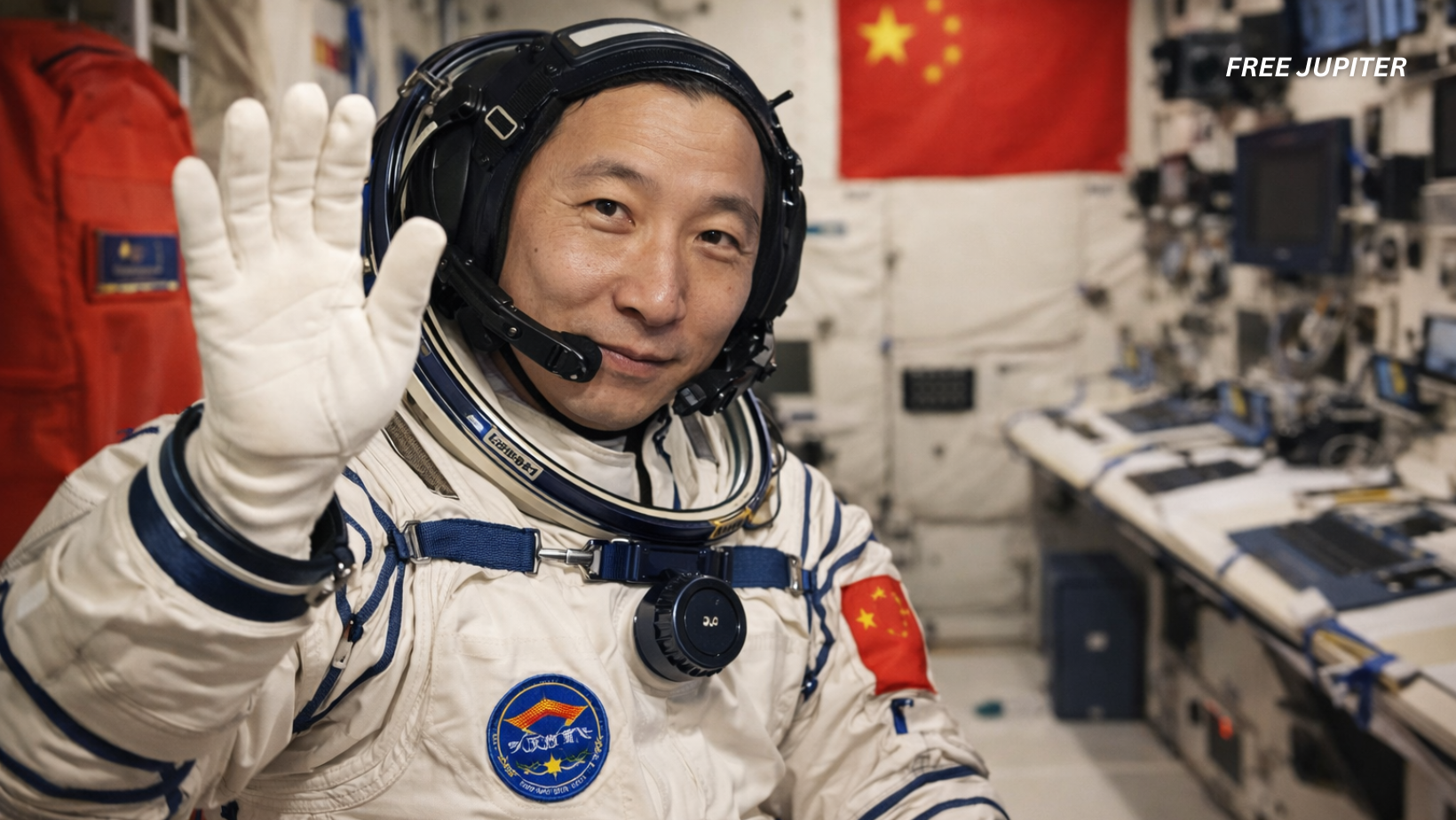
In 2003, during a moment that should have been defined by silence, China’s first astronaut heard something that science struggles to explain. Orbiting more than 300 kilometers above Earth inside the Shenzhou 5 spacecraft, Yang Liwei noticed a sound that did not belong there.
It was not loud. It was not violent. But it was clear enough to capture his full attention.
Yang later described it as a steady knocking noise, similar to someone tapping a metal container with a wooden object. In the emptiness of space, where sound should not travel at all, the noise stood out in an unsettling way. There was no visible cause. No warning signal. No equipment malfunction.
More than two decades later, the source of that sound remains unknown.
Silence Is One of Space’s Most Reliable Rules
Space is often portrayed as dramatic and loud in movies, filled with explosions and roaring engines. In reality, space is defined by silence.
Sound, as we experience it on Earth, depends on vibrations traveling through a medium. Air carries sound waves to our ears. Water does the same, which is why sound moves faster underwater. Solid materials can also transmit vibrations.
Outer space, however, is almost completely empty. There is no air to carry sound outside a spacecraft. This is why astronauts rely entirely on radio communication and internal systems to hear anything at all.
Because of this, any unexplained sound inside a spacecraft immediately raises questions. If something is heard, it usually comes from mechanical systems, onboard equipment, or the structure of the vehicle itself. When none of those sources can be identified, the mystery deepens.
Related article: Earth’s Seasons Are Now Oddly Out of Sync, New Space Data Has Revealed
A Historic Mission With an Unexpected Twist
Yang Liwei’s flight aboard Shenzhou 5 was a milestone for China. The mission lasted just over twenty one hours and completed fourteen orbits around Earth. With this achievement, China became the third country to independently send a human into orbit, following the Soviet Union and the United States.
The spacecraft performed well. Life support systems remained stable. Communication with mission control was clear. All major objectives were met.
Then came the knocking.
According to Yang, the sound did not feel as though it originated from inside the capsule. It seemed external, as if something was gently but deliberately striking the shell of the spacecraft. He checked the instruments. Everything appeared normal. He looked through the window. Nothing unusual was visible.
After returning to Earth, Yang attempted to recreate the sound during training simulations. Engineers examined the capsule carefully. No structural damage was found. No loose components were identified. The sound left no physical trace.
It existed only as a human experience.
When One Astronaut Becomes Several
If Yang Liwei had been the only person to hear the knocking, the story might have faded quietly into the background of spaceflight history. Stress, fatigue, or momentary sensory distortion could have been considered and the case closed.
But that did not happen.
In later years, Chinese state media confirmed that astronauts on subsequent Shenzhou missions in 2005 and 2008 reported hearing similar knocking sounds while in orbit. The descriptions closely matched Yang’s account. The sounds were repetitive, noticeable, and unexplained.
Different spacecraft configurations. Different crews. Same strange phenomenon.
Yang reportedly spoke to later astronauts before their missions, calmly explaining what he had experienced. He told them that if they heard the sound, they should not panic. It did not indicate danger, and it did not interfere with the mission.
Over time, the knocking became an acknowledged but unresolved part of China’s early spaceflight experience.
Scientific Explanations That Almost Work
Engineers and physicists have explored several explanations, but none fully account for all aspects of the phenomenon.
One of the most widely discussed ideas involves temperature changes. As a spacecraft orbits Earth, it repeatedly moves between intense sunlight and deep shadow. Temperatures can change dramatically within minutes. Metal and composite materials expand when heated and contract when cooled.
This process can produce popping or creaking sounds, similar to the noises heard in buildings as temperatures shift. Some scientists believe this could explain the knocking.
However, Yang described the sound as rhythmic and deliberate, not random or occasional. Thermal expansion noises are typically irregular, making this explanation incomplete.
Another possibility involves micrometeoroids. Space is filled with tiny particles moving at extremely high speeds. Even very small impacts can release energy. A minor collision might produce a brief noise.
The issue with this theory is that no external damage was found on the spacecraft. Additionally, Yang reported hearing the sound multiple times, which would suggest repeated impacts without any visible effect.
Related article: First-Ever Recording Captures Black Hole “Kicked” Across Space And Time
Could the Human Brain Be Responsible
Some researchers have considered whether the sound could have been a perceptual experience rather than a physical one. Spaceflight places the human body and mind under unique conditions. Isolation, confinement, altered sleep cycles, and heightened awareness can all influence perception.
Auditory misperceptions can occur under stress, but this explanation also falls short. The spacecraft environment was carefully controlled. Cabin pressure remained stable. No similar reports of hearing knocks were widely documented in other programs under similar conditions.
Most importantly, multiple astronauts reported the same experience across different missions. This makes a purely psychological explanation less convincing.
Other Strange Sounds in Space History
China’s experience is not unique in the broader history of space exploration.
During the Apollo 10 mission in 1969, astronauts reported hearing a high pitched whistling sound while orbiting the far side of the Moon. Temporarily cut off from communication with Earth, they jokingly referred to it as space music. Years later, NASA suggested the sound was likely caused by radio interference between spacecraft systems.
In more recent missions, probes like NASA’s Juno spacecraft and the Van Allen Probes have produced eerie audio recordings. In these cases, the sounds were created by converting electromagnetic data into sound for analysis. Humans did not hear these noises directly.
This distinction matters.
Yang Liwei’s experience involved no sensors and no data translation. The sound was heard directly by a human ear inside a functioning spacecraft, without any measurable signal to explain it.
Related article: What Space Actually Smells Like, According to Astronauts and Scientists
A Mystery That Quietly Endures
Despite the unanswered questions, the knocking sound did not lead to changes in spacecraft design or mission procedures. Chinese space authorities did not classify it as a threat. Astronauts were informed, but the phenomenon was treated as a manageable unknown.
From a scientific perspective, the incident remains unresolved. It challenges assumptions without offering enough evidence to overturn them. It sits in a gray area between physics, engineering, and human experience.
Today, the story remains a quiet footnote in space history. Not a warning. Not a breakthrough. Just a reminder that even in one of the most controlled environments humans can create, there are still moments that resist explanation.
In the vast silence of space, sometimes the most unsettling thing is not what is seen, but what is heard.
Featured image: GPT creation.
Friendly Note: FreeJupiter.com shares general information for curious minds. Please fact-check all claims and double-check health info with a qualified professional. 🌱